About Capreolus capreolus (Linnaeus, 1758)
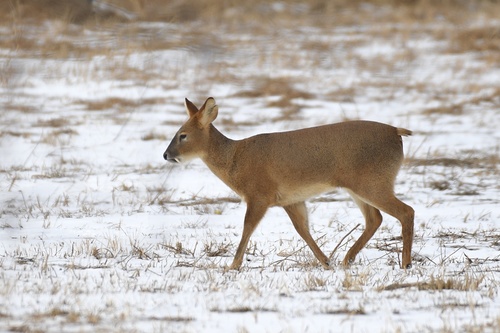
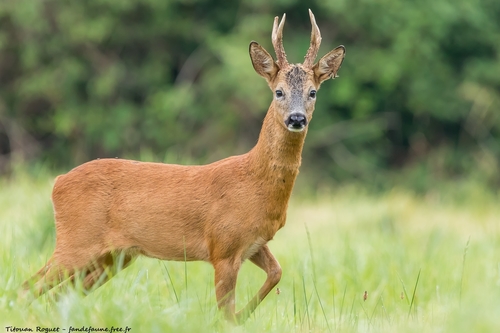
The roe deer (Capreolus capreolus (Linnaeus, 1758)) is a relatively small deer. Across most of its range, it has a body length of 95–135 cm (3 ft 1 in – 4 ft 5 in), a shoulder height of 63–67 cm (2 ft 1 in – 2 ft 2 in), and a weight of 15–35 kg (35–75 lb). Populations from the Urals and northern Kazakhstan are larger on average, growing to 145 cm (4 ft 9 in) in length and 85 cm (2 ft 9 in) in shoulder height, with body weights reaching up to 60 kg (130 lb); populations become smaller again further east, in the Transbaikal, Amur Oblast, and Primorsky Krai regions. In healthy populations where population density is controlled by hunting or predators, male roe deer (bucks) are slightly larger than female roe deer (does). Under other conditions, males can be similar in size to females, or slightly smaller. Bucks in good condition develop antlers up to 20–25 cm (8–10 in) long, with two or three points, and rarely four. When a male's antlers begin to regrow, they are covered in a thin, velvet-like fur that the buck sheds after the fur loses its blood supply. Males may speed up this process by rubbing their antlers on trees, which leaves their antlers hard and stiff for fights during the mating season. Unlike most cervids, roe deer begin regrowing antlers almost immediately after they shed their old antlers. In rare cases, some bucks have only a single antler branch, which is caused by a genetic defect. The roe deer is found across most of Europe, except for northernmost Scandinavia, Iceland, Ireland, and the Mediterranean Sea's islands. In the Mediterranean region, it is largely restricted to mountainous areas, and is absent or rare at low altitudes. An early Neolithic fossil record of the species exists from Jordan. This species lives across multiple habitats, including open agricultural areas and areas above the tree line, but requires access to food and cover. It retreats to dense woodland (especially among conifers) or bramble scrub to rest, but it is very opportunistic, and a hedgerow can provide enough cover. Roe deer in the southern Czech Republic live in almost entirely open agricultural land. The animal is more commonly spotted in areas with nearby forests to retreat to. It is a pioneer species commonly associated with early-stage successional biotic communities. During the Neolithic period in Europe, when farming humans began colonising the continent from the Middle East, roe deer were abundant and took advantage of forest and woodland areas cleared by Neolithic farmers. Polygamous roe deer males clash over territory in early summer and mate in early autumn. During courtship, when males chase females, they often flatten underbrush, leaving behind circular or figure-eight shaped areas of forest called 'roe rings', which are usually 1–3 m (3.3–9.8 ft) in diameter. In 1956, a speculation based on field evidence suggested roe deer form these rings around plants with ergot mould, but this claim has not been further substantiated. Males may also use their antlers to shovel through fallen foliage and soil to attract mates. Roebucks stop eating normally during the July and August breeding season. Females are monoestrous, and after delayed implantation usually give birth the following June, following a 10-month gestation period. They typically give birth to two spotted fawns of opposite sexes, that weigh 0.8–2.5 kg (1.8–5.5 lb). Fawns stay hidden in long grass to avoid predators, and are suckled by their mother several times a day for around three months. Young female roe deer can begin reproducing when they are around six months old. During the mating season, a male roe deer may mount the same doe multiple times over a period of several hours. A roe deer can live up to 20 years, but it does not usually reach this age. A typical wild life span is seven to eight years, or up to ten years. The roe deer population displays irruptive growth. It is extremely fecund and can double its population every year; it shows a delayed reaction to population density, with females maintaining similar fecundity even at high population densities. Population structure is shaped by available nutrition: in irrupting populations, few animals are older than six years. In stagnant or declining populations, fawn mortality is very high, and a large share of the population is older than seven years. Mortality is highest in the first weeks after birth (from predation or sometimes farm machinery), or in the first winter (from starvation or disease), reaching up to 90%. It is a main prey species of the Persian leopard (Panthera pardus tulliana) in the Alborz Mountains of Iran. The nematode Spiculopteragia asymmetrica infects this deer. Compared to other large herbivores and omnivores in Iran, it is a poor disperser of plant seeds, even though it consumes relatively more seeds. The roe deer is a game animal of great economic value in Europe, providing large amounts of meat and generating millions of euros from sport hunting. In 1998, around 2,500,000 roe deer were shot in western Europe. In Germany during the 1990s, 700,000 roe deer were harvested per year. This harvest level is not enough to slow the species' population growth, so the roe deer population continues to increase. It is the main source of venison in Europe. Its meat, like most game meat, is darker in colour than the meat of most farm-raised deer.