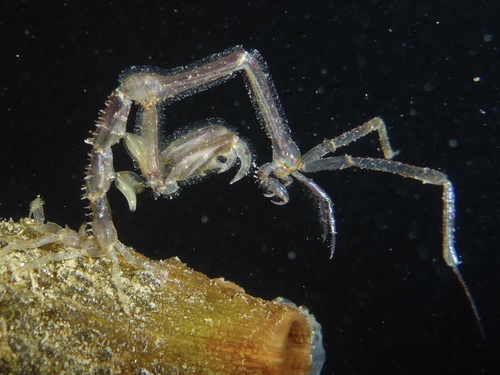
About Caprella mutica Schurin, 1935
Like all caprellid amphipods, Caprella mutica (Schurin, 1935) have slender bodies and elongated appendages. Their skeletal appearance gives them the common names "skeleton shrimp" or "ghost shrimp"; paired with their distinctive upright feeding posture, they look strikingly similar to stick insects and "starved praying mantises". C. mutica individuals vary in color, ranging from translucent pale green, brown, cream, orange, deep red, and purple to even turquoise, with color matching the substrate they inhabit. Female C. mutica have brood pouches speckled with red spots. C. mutica is a relatively large amphipod species that is sexually dimorphic, with males growing much larger than females. Males average 25 to 30 mm (0.98 to 1.18 in) in length, though recorded specimens can reach up to 50 mm (2.0 in). By contrast, females average only 15 to 20 mm (0.59 to 0.79 in) in length. The body of C. mutica is divided into three regions: the cephalon (head), the pereon (thorax), and the abdomen. The pereon makes up most of the body's total length, and is split into seven segments called pereonites. The rounded, smooth cephalon is fused to the first pereonite, while a highly reduced, nearly invisible abdomen attaches to the posterior end of the seventh pereonite. In males, the first two pereonites are elongated, with the second pereonite being the longest of all pereonites. These two segments are densely covered in long setae (bristles), giving males a hairy appearance. The second pereonite also has two to three pairs of spines on its back, plus an extra two pairs on the sides near the base of the limbs. The remaining pereonites (third through seventh) do not have the dense setae covering seen on the first two. The third pereonite has seven pairs of spines on its back, while the fourth pereonite has eight pairs. Both the third and fourth pereonites have three to seven pairs of spines near the base of the gills. The fifth pereonite has five pairs of back spines and one pair of spines on the sides. The sixth and seventh pereonites each have two pairs of back spines, located at their centers and near their posterior ends. Females differ from males in having much shorter pereonites that lack the dense setae covering. The cephalon and first pereonite of females each have one pair of spines, though these spines are sometimes absent. Like other crustaceans, C. mutica has two pairs of antennae. The first (outer) pair is more than half the total body length. The segments of the antenna peduncles (base) are three times as long as the flagellae (the whip-like ends of the antennae), and each flagellum has 22 segments. The second (inner) pair of antennae is less than half the length of the first pair, and has two rows of long setae on the ventral surfaces of its peduncle segments. Mandibles and maxillae are located on the anterior ventral surface of the cephalon. Maxillipeds, a modified pair of appendages, act as accessory mouthparts. Appendages that grow from pereonites are called pereopods. The first two pairs of pereopods are highly modified into raptorial grasping appendages called gnathopods, which resemble the arms of praying mantises. Gnathopod segments are split into two parts that fold into each other: the propodus (forelimb) and the dactylus (finger) at the tip. The first pair of gnathopods is considerably smaller than the second pair, and arises close to the maxillipeds. The inside margins of the propodi have two spines, and both the propodi and dactyli have serrated inner edges. The second pair of gnathopods is very large, with two large spines on the middle and upper edges of the inner margin of the propodus palm. The upper spine is called the "poison spine" or "poison tooth", and may be the same size as or much larger than the lower spine, called the "closing spine". Despite its name, it is still unclear whether the poison spine produces actual venom, though it can inflict potentially lethal injuries on small organisms. Recent studies have linked the spines to pores that connect to possible toxin-producing glands. The dactyli of the second gnathopods are powerful and curved into a scimitar shape. The second pair of gnathopods is densely covered in hair-like setae, while the first pair only has setae on its posterior margins. The third and fourth pereopods are absent. In their place, two pairs of elongated oval gills arise from the third and fourth pereonites, respectively. In mature females, two brood pouches also develop on the third and fourth pereonites, formed by oostegites: plate-like expansions from the basal coxae segments of the appendages. The fifth to seventh pereopods act as clasping appendages. All of these pereopods have propodi with two spines on their inner margins. The seventh pair of pereopods is the longest of the three pairs, followed by the sixth pair, then the fifth pair. C. mutica very closely resembles Caprella acanthogaster, another species native to East Asian waters. It can be difficult to tell the two species apart, especially because C. mutica shows significant morphological variation among males. C. mutica can only be reliably distinguished by the setose covering on its first and second pereonites (which are smooth in C. acanthogaster) and its elongated oval gills (which are linear in C. acanthogaster). In their native habitat, C. mutica lives in the infralittoral (or neritic) and littoral zones of sheltered bodies of water, at depths from approximately 0.7 to 13 m (2.3 to 42.7 ft). They may spend their entire lives clinging to a substrate in an upright position. These substrates are typically floating, with filamentous, leafy, branching, or turf-like structures that match the C. mutica body color for camouflage and can transport the individuals. C. mutica is a poor swimmer, and moves primarily in an undulating, inchworm-like fashion using its posterior pereopods and gnathopods. They are generally reluctant to release their substrate, and only do so when agitated. Different populations on different substrates show different exoskeleton coloration, suggesting C. mutica can change color to blend into its environment, though the exact mechanism of this color change remains unknown. Common substrates for C. mutica in native habitats include beds and floating clumps of macroalgae including Sargassum muticum, Sargassum miyabei, Sargassum pallidum, Neorhodomela larix, Polysiphonia morrowii, Cystoseira crassipes, Laminaria japonica, Chondrus spp., and Desmarestia viridis; as well as marine plants (such as eelgrass of the genus Zostera), hydrozoans, and bryozoans. In their introduced ranges, C. mutica also seeks out organisms with structures their slender bodies can easily blend into. These include macroalgae like Ulva lactuca, Ceramium spp., Plocamium spp., Cladophora spp., Chorda filum, Fucus vesiculosus, Pylaiella spp., and the introduced Sargassum muticum; hydrozoans like Obelia spp. and Tubularia indivisa; bryozoans; tube-building amphipods like Monocorophium acherusicum and Jassa marmorata; and even soft-bodied tunicates like Ascidiella aspersa and Ciona intestinalis. In both native and introduced ranges, C. mutica is synanthropic, and is abundant in fouling communities on artificial structures including submerged ropes, fishing nets, pilings, docks, buoys, aquaculture equipment, oil rig platforms, ship hulls, and offshore wind farms. In introduced ranges (particularly in Europe), C. mutica is primarily, and sometimes even exclusively, found living on artificial structures. C. mutica can reach extremely high population densities on artificial structures in its introduced range. A survey of C. mutica populations in Chaleur Bay, Quebec recorded concentrations of 468,800 individuals per 1 m² (11 sq ft); while a survey in Dunstaffnage Bay, Firth of Lorn, Scotland recorded 319,000 individuals per 1 m² (11 sq ft). By contrast, C. mutica in native habitats reaches maximum densities of only around 1,220 to 2,600 individuals per 1 m² (11 sq ft). Population numbers peak in late summer (August to September), before dropping sharply during the winter months. C. mutica is native to subarctic regions of the Sea of Japan in northwestern Asia. It was first discovered in Peter the Great Gulf, Primorsky Krai, a federal subject of Russia. It was redescribed by Japanese marine biologist Ishitaro Arimoto in 1976, who noted it was also present on the island of Hokkaido and surrounding regions. Over 40 years, the species has spread to other parts of the world through multiple accidental introductions (both primary and "stepping stone" secondary introductions) via ship hulls, ballast water from international maritime traffic, aquaculture equipment, and shipments of Pacific oyster (Crassostrea gigas). Genetic studies of mitochondrial DNA (mtDNA) from C. mutica populations show high genetic diversity in the Sea of Japan region, which clearly confirms this as the species' native range. By contrast, non-native populations in North America, Europe, and New Zealand have low genetic diversity. The presence of certain genetic material in non-native populations makes it probable that there are other unknown native regions for C. mutica, though this could also simply be a result of too-small sample groups used in studies. Comparisons of mtDNA from different populations allow researchers to trace likely introduction routes. The most probable route is that the original non-native introduction was to the west coast of North America, which has the highest genetic diversity among non-native populations. Multiple later introductions occurred in Europe and eastern North America. From these regions, additional populations were transported to nearby ports. Europe and eastern North America are also the probable source of the New Zealand C. mutica population. C. mutica lives in shallow protected marine bodies of water, and is often found in dense colonies attached to submerged artificial structures, marine macroalgae, and other organisms. It is primarily an omnivorous detritivore, but can adapt to other feeding strategies depending on food availability. It is preyed on by fish, crabs, and multiple other predators. C. mutica is generally found in temperate and subarctic regions. It cannot tolerate water temperatures higher than 28.3 °C (82.9 °F), and dies within five minutes when exposed to 40 °C (104 °F) water. On the lower end of the temperature range, it can survive temperatures lower than −1.9 °C (28.6 °F), but becomes immobile, entering a state of suspended animation if not completely immobilized. C. mutica cannot tolerate salinities below 15 psu, and cannot survive in freshwater habitats. However, observations in native habitats show it can survive salinities as low as 11 psu. It is also sensitive to air exposure, and dies within an hour if removed from water. C. mutica reproduces year-round, with peak breeding seasons in summer. Males are highly aggressive and compete sexually for smaller females. In laboratory conditions, eggs, which average 40 per female, are incubated for around 5 days at 22 °C (72 °F) in the female's brood pouch. After hatching, individuals reach sexual maturity in around 21 to 46 days. The average lifespan under laboratory conditions is 68.8 days for males and 82 days for females. In wild C. mutica populations, there are far more females than males. This may be because males aggressively defend females from competing males, which leads to high male mortality. The larger size and greater visibility of males also makes them more vulnerable to vision-reliant predators such as fish. C. mutica is an r-strategist species. It reproduces year-round, with peak breeding in summer (March to July). Males engage in sexual competition and courting behavior. They aggressively fight in "boxing matches" using their large second pair of gnathopods when near receptive females. These encounters often end in death, as the gnathopods and their poison teeth can impale or slice an opponent in half. Males also repeatedly touch the female exoskeleton with their antennae to detect signs of moulting (ecdysis). Like all crustaceans, females are only able to mate shortly after shedding their old hardened exoskeleton. Amplexus lasts 10 to 15 minutes. After mating, males defend the female for a short period (around 15 minutes). After this period, females become aggressive and drive the male away. Females then bend their fourth and fifth pereonites at a 90-degree angle. Once their genital openings (located on the fifth pereonite) align with the opening of the brood pouches, they quickly deposit fertilized eggs into the pouches. Females carrying fertilized eggs remain aggressive toward males throughout brooding, a maternal behavior that protects developing embryos from male aggression. A female's brood pouch can hold 3 to 363 eggs, averaging 74 eggs. Larger females tend to produce more eggs. Eggs are incubated inside the brood pouch for 30 to 40 days before hatching. Like all amphipods, caprellids lack a planktonic larval stage, and hatchlings resemble small adult individuals. Juveniles may cling to their mother after hatching, and females continue to protect offspring that stay close. Hatchlings measure around 1.3 to 1.8 mm (0.051 to 0.071 in), and grow an average of 0.4 to 0.9 mm (0.016 to 0.035 in) per instar. C. mutica matures rapidly, moulting an average of once per week until it enters the "premature stage", becoming sexually differentiated at the fifth instar. The time between moulting cycles becomes longer in the seventh to ninth instars, averaging once every two weeks until sexual maturity. Sexual maturity can occur as early as 21 days and no later than 46 days after hatching, depending on environmental conditions. In wild populations, however, this can take up to six months when juveniles hatch in late summer. After the seventh instar, males begin increasing in size at a faster rate with each successive moult. By contrast, females produce their first brood at the seventh instar. As adults, they may moult several times, becoming sexually receptive each time until death. The average lifespan of C. mutica under laboratory conditions is 68.8 days for males and 82 days for females.

