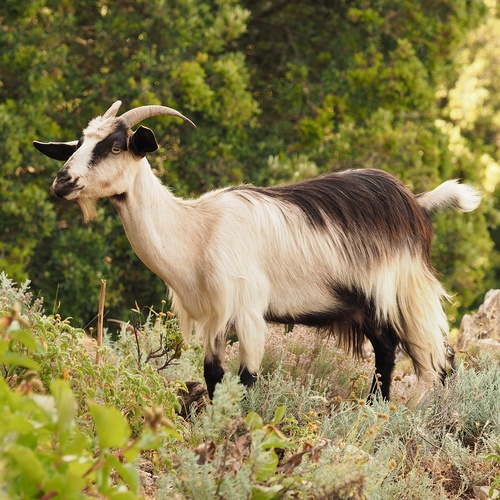
About Capra hircus aegagrus Erxleben, 1777
Each goat breed has a specific weight range, from over 140 kg (310 lb) for mature males (bucks) of large breeds like the Boer, down to 20 to 27 kg (44 to 60 lb) for mature females (does) of smaller breeds. Different strains or bloodlines within the same breed may have different accepted standard sizes. At the smallest end of the size spectrum are miniature breeds such as the African Pygmy, which measure 41 to 58 cm (16 to 23 in) at the shoulder when fully grown. Most goats naturally have two horns, with shape and size varying by breed. Polycerate goats, which can have up to eight horns, have been recorded, though this trait is a genetic rarity. Unlike cattle, goats have not been successfully bred to be consistently polled (hornless), because the genes that determine sex and the genes that determine horn growth are closely linked. Breeding two genetically polled goats together produces a high number of intersex offspring, which are typically sterile. Goat horns are made of living bone covered by keratin and other proteins, and they are used for defense, establishing dominance, marking territory, and thermoregulation. Both male and female goats can have beards, and many goat types—most commonly dairy goats, dairy-cross Boers, and pygmy goats—may have wattles, one hanging from each side of the neck. Goats have horizontal, slit-shaped pupils. This pupil shape lets them see well in both night and day, gives them a broad field of vision on either side to spot predators, and prevents them from being dazzled by sunlight from above. Goats do not have tear ducts. Goats are ruminants, with a four-chambered stomach made up of the rumen, reticulum, omasum, and abomasum. Like other ruminant mammals, they are even-toed ungulates. Female goats have an udder with two teats, which differs from cattle that have four teats. Boer goats are an exception, and may sometimes have up to eight teats. Goats are diploid, with two sets of 30 chromosomes. Goats are naturally curious, and are agile enough to climb and balance in precarious locations. This agility makes them the only ruminant that regularly climbs trees. These behaviors make goats well known for escaping their enclosures by testing fences and pens. If any part of a fence can be pushed through or climbed over, goats will almost always escape. Some studies have found goats to be as intelligent as dogs. When grouped together, goats show less herding instinct than sheep. When grazing without disturbance, they spread out across a field or range, rather than feeding side-by-side like sheep do. When nursing their young, nanny goats leave their kids separated (a behavior called "lying out") instead of keeping them clustered together, as sheep do. Goats generally turn to face an intruder, and goat bucks are more likely to charge or butt humans than sheep rams are. A 2016 study found that goats attempt to communicate with people similarly to other domesticated animals like dogs and horses, and will look to a human for help when faced with an unfamiliar, modified challenge. Goats reach puberty between three and 15 months of age, with timing depending on breed and nutritional status. Many breeders choose to delay breeding until a doe has reached 70% of her expected adult weight, but this separation is rarely achievable in extensively managed open-range herds. For Swiss and northern goat breeds, uncastrated males (bucks) enter breeding condition called rut in the fall, matching the does' seasonal heat cycles. Bucks from equatorial breeds may have seasonal reduced fertility, but like does they are capable of breeding at any time of year. During rut, bucks experience decreased appetite and show obsessive interest in does. A buck in rut performs flehmen lip curling and urinates on his forelegs and face. Sebaceous scent glands at the base of the horns contribute to the male goat's strong odor, which is important for attracting females. Some does will not mate with a buck that has had its scent glands removed. The average gestation length for goats is approximately 150 days. Twins are the most typical outcome of pregnancy, with single births and triplet births also common. Litters of quadruplets, quintuplets, and even sextuplet kids occur less frequently. Goat birth, called kidding, generally happens without complications. Just before kidding, a doe will develop a sunken area around her tail and hips, and breathe heavily. She may appear anxious, become restless, and show increased affection toward her keeper. Goat mothers often eat the placenta after birth; this provides them with much-needed nutrients, helps stop bleeding, and follows the same behavior seen in wild herbivores like deer, which reduces the chance that predators will be drawn to the scent of birth. Freshening, the process of coming into milk production, usually happens at kidding, though milk production is also relatively common in unbred young dairy does (doelings). Milk production varies based on the doe's breed, age, overall quality, and diet. Dairy goats typically produce between 680 and 1,810 kg (1,500 and 4,000 lb) of milk over a 305-day lactation period. On average, a good quality dairy doe will produce at least 3 kg (6 lb) of milk per day while she is lactating. First-time milkers may produce less, though exceptional individuals can produce as much as 7 kg (16 lb) or more. After the lactation period ends, the doe will "dry off", typically after she has been bred again. Occasionally, goats that have not been bred and are continuously milked will continue lactating longer than the typical 305-day period. Male lactation sometimes occurs in goats. Goats are used to produce milk, specialty wools, meat, and goatskin. Some charities donate goats to people living in poverty in low-income countries, based on the idea that providing useful productive assets reduces poverty more effectively than cash. However, the cost of acquiring goats and distributing them to recipients can be high. Some national militaries use goats to train combat medics. In the United States, goats became the primary animal species used for this purpose after the Pentagon stopped using dogs for medical training in the 1980s. While modern training mannequins effectively simulate human body functions, trainees report that working with a living goat creates a sense of urgency that only real live trauma can provide. This practice has drawn public criticism from animal-rights advocacy groups.