About Capito auratus (Dumont, 1805)
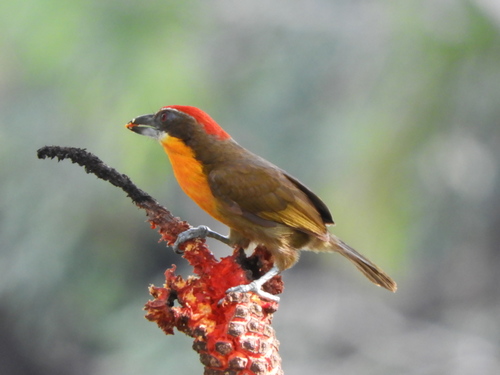
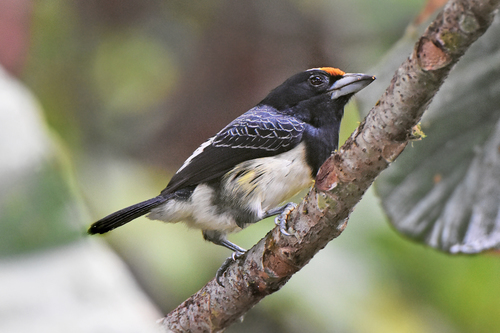
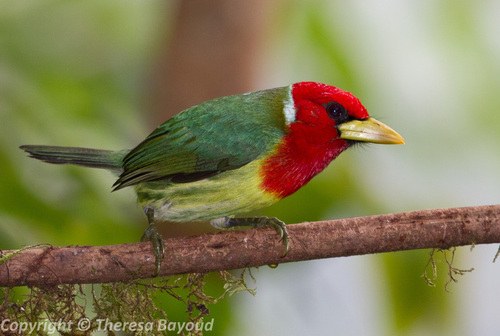
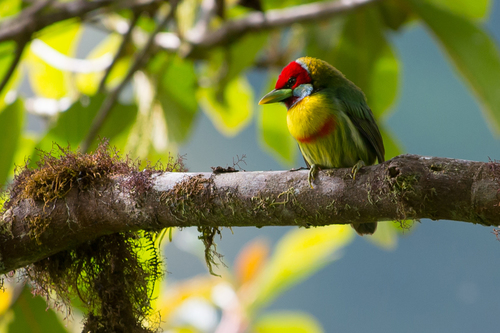
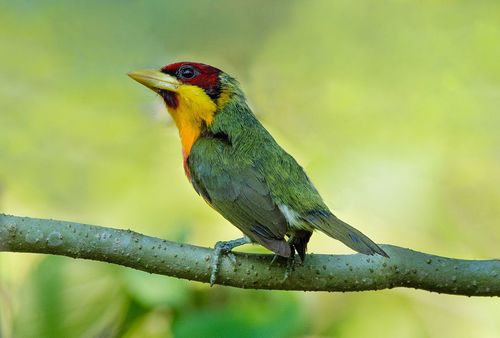
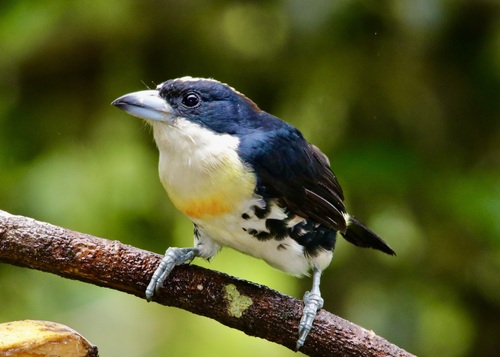
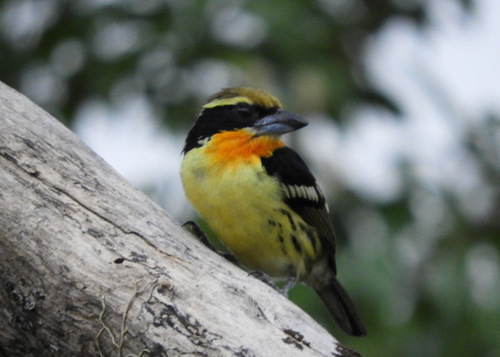
This species, commonly known as the gilded barbet, has a scientific name of Capito auratus (Dumont, 1805). It reaches a total length of approximately 20 cm (8 in). Like other New World barbets, it is a thickset bird with a relatively large head and a stubby bill. Its upperparts, tail, wings, and face mask are mainly black. A spotty yellow bar crosses its greater wing coverts, the remiges have narrow yellow edging, and the tertials have yellow tips. Narrow yellow eyebrows also extend as two parallel lines over the mantle. Its belly is mainly pale yellow, with black streaking present on the flanks. Throat color ranges from red to orange, and crown color ranges from deep yellow to brownish-orange to reddish-orange, depending on the subspecies. Females resemble males, but have extensive orange-yellow edging on the wing-coverts, yellowish streaking on the auriculars and back, and black streaking on the flanks that also extends across the chest. In females of the westernmost subspecies punctatus, the throat is streaked with black. Both sexes have dark maroon irides, greyish legs, and a grey bill with a broad black tip. It occurs in Bolivia, Brazil, Colombia, Ecuador, Peru, and Venezuela, within the Orinoco River Basin and western Amazon Basin. It was formerly classified as a subspecies of the black-spotted barbet found in northeastern South America. Its natural habitats are tropical moist lowland forests and woodland. It occurs mainly in lowlands, but also ranges into the lower foothills of the eastern Andes. It is largely frugivorous. Its range covers eastern Andes drainages leading to the rivers of the western Amazon Basin, extending from eastern Colombia and Venezuela, through eastern Ecuador and north to southeastern Peru, to northern Bolivia. In Bolivia, the species is only found on headwater tributaries of the northeasterly flowing Madeira River. In the southwestern Amazon Basin, its eastern range limit is the Purus River, west of the Madeira. In the northwestern Amazon Basin, its eastern range limit is central Roraima state, Brazil, at the south-flowing Branco River. Its contiguous range extends northwest into all of eastern Venezuela, approaching the Guyana border. The gilded barbet's range occupies the eastern side of the Caribbean north-flowing Orinoco River drainage, but it avoids the lower-half riverine strip by 150 km; its range occurs across the upper-half of the Orinoco River, extending south into the eastern border area of Colombia. A small range extension reaches southeast into central Bolivia, also within Madeira River tributary areas.