About Cantorchilus nigricapillus (P.L.Sclater, 1860)
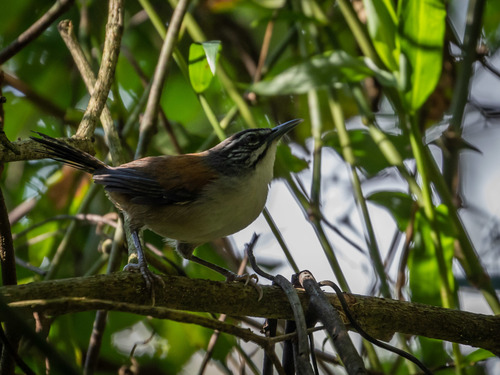
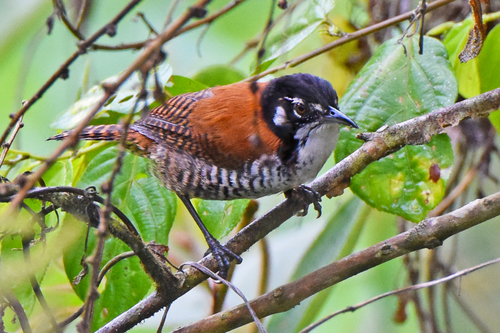
This species is the bay wren, with the scientific name Cantorchilus nigricapillus (P.L. Sclater, 1860). Bay wrens measure 12.6 to 15.6 cm (5.0 to 6.1 in) in length. Eight specimens collected from Panama weighed between 17.7 and 26.3 g (0.62 to 0.93 oz). Adults of the nominate subspecies have a black face marked by a narrow white supercilium, a partial eyering, and a white patch on the back of the cheek. Their crown and nape are black, while the rest of their upperparts are a rich chestnut shade. The tail is rich brown with prominent bold black bars. The throat and breast are white, transitioning to rufous brown on the lower belly and flanks. Black bars cross all underparts from the breast down to the vent area. Juveniles have essentially the same plumage pattern as adults, but are paler with less well-defined markings. Other recognized subspecies differ from the nominate in the extent and intensity of certain colors, and in the thickness and amount of barring. The bay wren's overall range extends from Nicaragua to Ecuador, with subspecies distributed as follows: C. n. costaricensis ranges from northeastern Nicaragua through Caribbean Costa Rica into western Panama; C. n. castaneus ranges from Veraguas Province in west-central Panama to the Canal Zone; C. n. odicus is found on Isla Escudo de Veraguas, off the Caribbean coast of western Panama; C. n. reditus occurs on the Caribbean slope of eastern Panama; C. n. schottii ranges from Darién Province in eastern Panama into the Antioquia and Chocó Departments of northwestern Colombia; C. n. connectens ranges from the Cauca and Nariño Departments of southwestern Colombia into Esmeraldas Province in far northern Ecuador; C. n. nigricapillus is found in western Ecuador, from Esmeraldas Province south to El Oro Province. Across most of its range, the bay wren is closely tied to water, though populations in Nicaragua occupy drier habitat. It lives in dense, fairly low vegetation, including thickets along watercourses, overgrown clearings, roadsides, and the understory of secondary forest. It can also be found in forest interiors if the undergrowth there is dense enough.