About Cantorchilus longirostris (Vieillot, 1819)
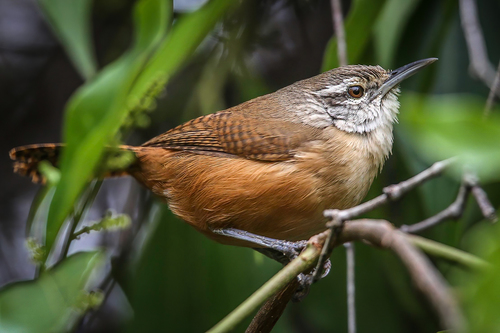
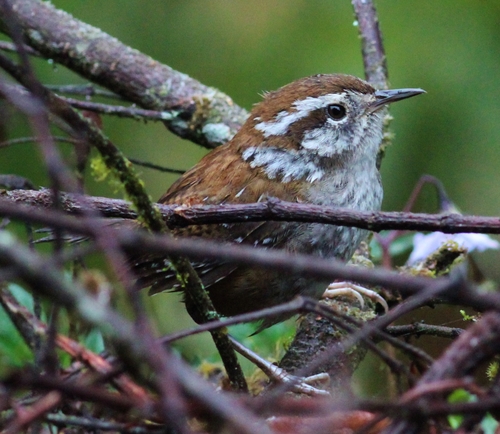
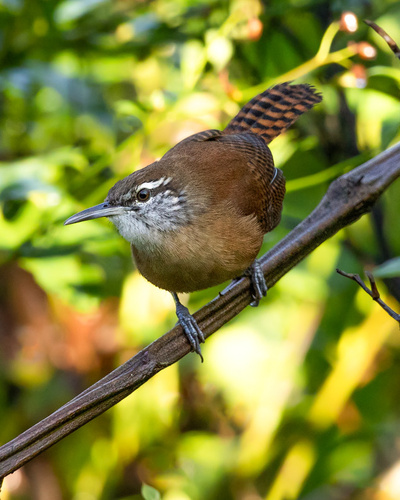
The long-billed wren (scientific name Cantorchilus longirostris) is 19 to 21.5 cm (7.5 to 8.5 in) long and weighs 20 to 21 g (0.71 to 0.74 oz). For adults of the nominate subspecies, the crown and nape are a rich dark brown, which becomes progressively more reddish toward the rump. The lower back has obscure dark bars, and the tail is reddish brown with darker bars. Adults of this subspecies have an off-white supercilium, a darkish brown eyestripe, cheeks mottled with off-white and dark gray, and a blackish malar stripe. Their throat color ranges from whitish to pale buff; the chest is reddish buff, and the belly is a deep rich buff. Juveniles are almost identical to adults, except their facial markings are less distinct. The subspecies C. l. bahiae is paler overall than the nominate subspecies, with much less saturated underpart colors. C. l. bahiae is the more northerly subspecies of the long-billed wren, found in the "bulge" of eastern Brazil, ranging from Piauí south to Minas Gerais and east to the Atlantic coast. The nominate subspecies C. l. longirostris occurs in a narrower coastal band, extending from Bahia south to eastern Santa Catarina. The species as a whole inhabits secondary forest, edges and shrubby clearings of primary forest, mangroves, caatinga, and restinga. It occurs at elevations ranging from sea level up to 900 m (3,000 ft).