About Cantorchilus leucotis (Lafresnaye, 1845)
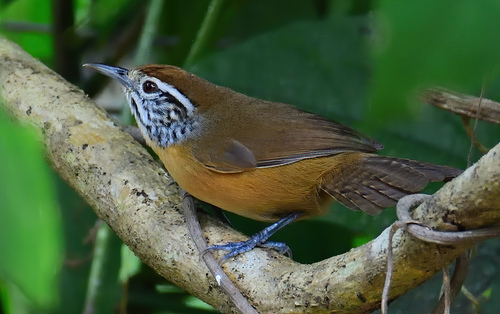
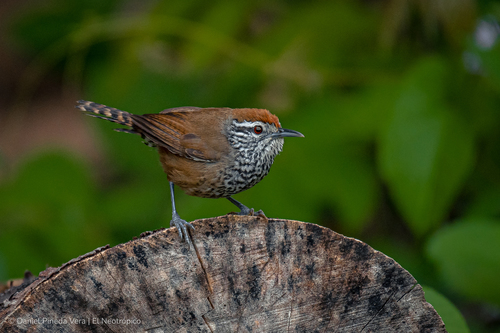
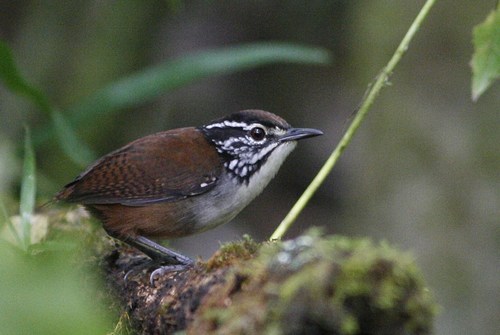
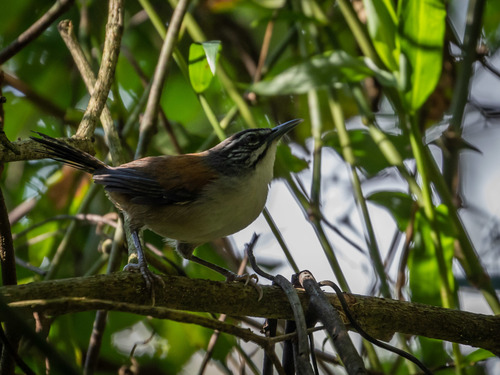
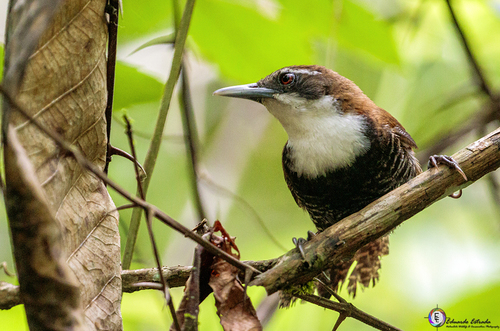
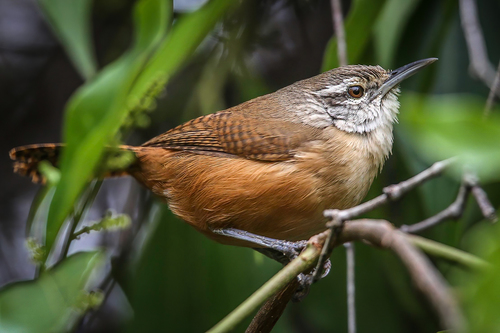
This species, commonly called the buff-breasted wren, has the scientific name Cantorchilus leucotis (Lafresnaye, 1845). Males weigh between 18.5 and 22.8 g (0.65 to 0.80 oz), while females are lighter, weighing 16.0 to 19.5 g (0.56 to 0.69 oz). The sexes are similar in appearance beyond this weight difference. There is notable plumage variation across the species' large range. In adult individuals, the head, nape, shoulders, tail, and back are colored rufescent to grayish brown, and the tail has heavy barring. The throat, supercilium, and the remaining areas of the face range in color from whitish through gray to gray-brown. The chest is buffy, and the belly is a more cinnamon shade. Fledglings are duller overall than adults, and the buff color of their chest is paler. The core range of the buff-breasted wren is in northern and central South America, particularly the Amazon Basin. Its range covers most of Venezuela, and northern Colombia extending east into eastern Panama. To the west along the Andes and south through Amazonian eastern Peru, the species only enters the extreme northwest border regions of Bolivia. The range also includes the Guianas, Ilha de Marajo (the island at the Amazon River outlet), and Panama's Pearl Islands. In southeastern Brazil, the range covers the entire central-southern and southeast Amazon Basin, extending from here almost to Brazil's southeastern Atlantic coast. It is mainly found in the southern Cerrado, and may also occur into the adjacent northeastern Pantanal. Buff-breasted wrens live in a variety of habitats, most of which feature low to medium height vegetation. Common habitat examples include secondary forest, its edges, and regenerating clearings. Mangrove forest and shade coffee plantations are less important habitats for the species. In Venezuela, the species only lives in gallery forest along waterways in areas that are otherwise grassland. In Amazonia, it is mostly found on the borders of várzea forest and on older river islands. It has been observed in primary forest in Bolivia, and the subspecies C. l. collinus lives in the dry scrub of Colombia's Serranía de Macuira.