About Canthigaster valentini (Bleeker, 1853)
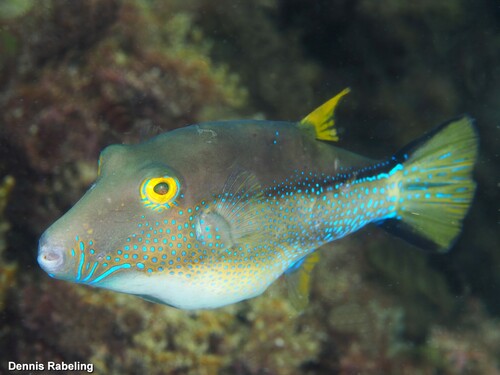
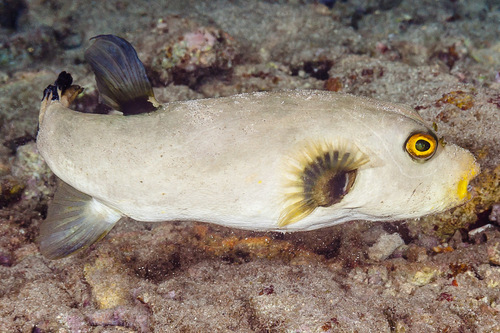
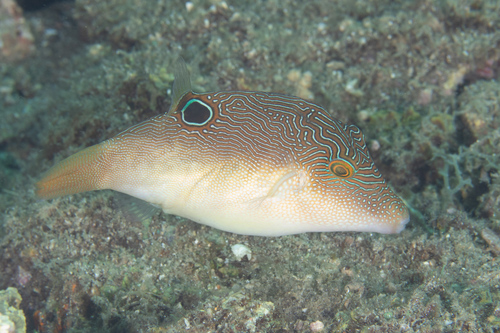
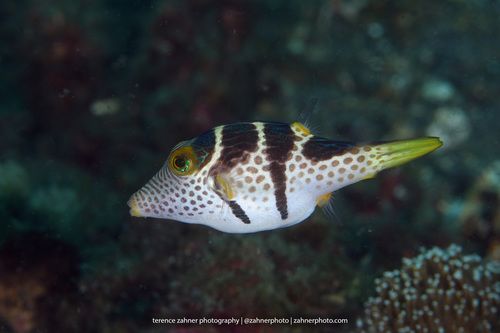
Valentin's sharpnose puffer, scientifically named Canthigaster valentini (Bleeker, 1853), is also commonly called the saddled puffer or black saddled toby. It is a demersal marine fish that belongs to the family Tetraodontidae. This is a small fish that reaches a maximum length of 11 centimetres. It is widely distributed across tropical and subtropical waters, from the Indian Ocean (including the Red Sea) all the way to the oceanic islands of the Pacific Ocean. It lives in rocky reefs, coral reefs, lagoons, and external reefs, at depths of up to 55 metres. Canthigaster valentini is active during the daytime (diurnal). It has four distinct black saddle-shaped stripes on its back. Its head is blue-grey, and its main body is white with speckled blue-grey spots. Hints of yellow appear on its tail and fins, and there is a rainbow-colored streak behind its eyes. It is an omnivore that feeds primarily on filamentous green and red algae and tunicates, with smaller amounts of its diet made up of corals, bryozoans, polychaetes, echinoderms, mollusks, and brown and coralline red algae. Valentin's sharpnose puffers are highly poisonous when eaten. They are occasionally found swimming in schools with Paraluteres prionurus, a non-toxic filefish that has evolved to mimic the very toxic C. valentini to gain protection from predators.
The toxin found in C. valentini, as well as other pufferfish species, is one of the most potent naturally occurring toxins known. It is a neurotoxin called tetrodotoxin, which is present in the skin and other tissues of C. valentini. This toxin is lethal to many fish species, which makes C. valentini unpalatable to predators. Because of this unpalatability, both adult C. valentini and their larvae and eggs face a low threat of predation. According to existing observations, this reduced predation risk causes the species to have different reproductive behaviors compared to other fish species that do not have this level of toxin protection. C. valentini's toxic skin makes it a well-known model for Batesian mimicry, specifically for the similarly colored filefish species Paraluteres prionurus, which benefits from the low predation risk associated with C. valentini's toxic reputation.