About Canthigaster capistrata (Lowe, 1839)
Canthigaster capistrata (Lowe, 1839) is a species of pufferfish in the family Tetradontidae, subfamily Canthigasterinae. Members of this subfamily are characterized by laterally compressed bodies, pointed snouts, and small gill openings. Like other tetradontids, Canthigaster capistrata produces the lethal toxin tetrodotoxin, which it advertises to predators with bold, bright body color patterns in an aposematic warning.
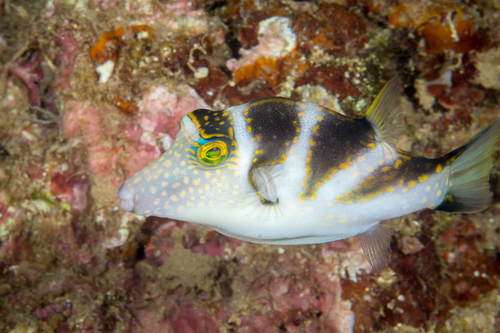
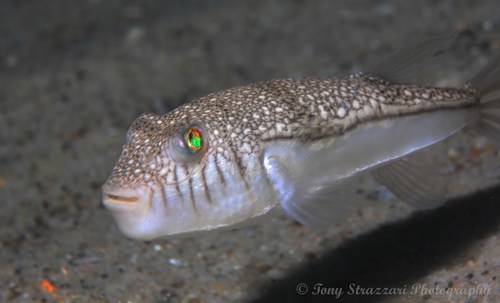
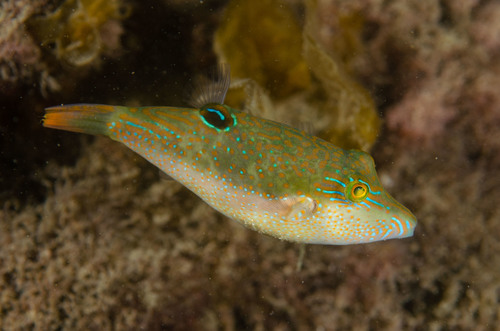
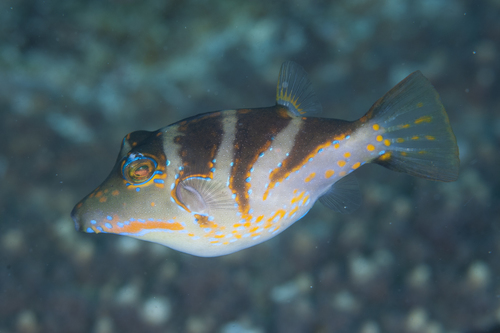
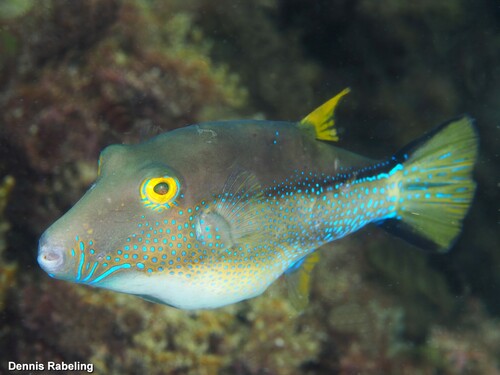
Only recently has C. capistrata been recognized as a distinct species; previously, it was classified as a junior synonym of C. rostrata. Key identifying traits of C. capistrata include 9–10 dorsal rays, 9 anal fin rays, and 14–16 pectoral rays per fin. It has a tan body with darker regions on the dorsal and ventral sides, with spots covering the entire body except the area ventral to the pectoral fins. It has a distinct long dark stripe running from the caudal peduncle up to the pectoral fin. The body is speckled with gray, blue, and bright blue dots, and there are bars on the pointed snout.
To distinguish C. capistrata from other species in the genus Canthigaster, note that it lacks a spot near the dorsal fin, and lacks the dark stripe extending from the caudal fin margin into the caudal peduncle that is present in close relatives like C. rostrata. C. capistrata does have a dark longitudinal stripe running from the caudal-fin margin up to the base of the pectoral fin. There is a strong color contrast between the darker dorsal region above this stripe and the central region below it, with the dorsal region having far fewer blue dots than the ventral region.
This species has a heavy, blunt body, with both the dorsal and anal fins positioned farther back on the body. Like all members of the genus Canthigaster, it lacks pelvic fins. Its jaws form a beak-like shape, eyes are located centrally in the posterior part of the head, and the caudal fin is truncated or slightly rounded. While this species produces tetrodotoxin, which is lethal to other fish, some related pufferfish species may produce saxitoxin instead, or both toxins, and toxin distribution within the body varies by species. Tetrodotoxin has been extracted from the muscles, liver, intestine, and other organs of C. capistrata in research studies.
Canthigaster capistrata is native to the East Atlantic, where it has been recorded from the Madeira Islands, Azores, Selvagen Islands, Canary Islands, and Cape Verde Archipelago. It was historically considered a Macaronesian endemic species, and it has a broader distribution across Macaronesia. It inhabits rocky areas, coral reefs, seagrass meadows, and seaweed bottoms at depths of 1 to 40 meters. Some individuals have also been found near shipwrecks, per recorded study data. The species is native and common in the Azores, which lie near the Mid-Atlantic Ridge. As the Azores are geologically relatively recently formed, natural colonization via ocean currents occurs frequently there, and very few species introductions or invasions have been recorded, likely due to the islands' geographic isolation. Currently, sea warming is shifting C. capistrata populations further northward into the Azores.