About Canthidermis sufflamen (Mitchill, 1815)
Canthidermis sufflamen was first described by Samuel L. Mitchill, M.D. in 1815, published in the Transactions of the Literary and Philosophical Society of New York, where it was named "trigger file-fish" and classified under the genus Balistes as Balistes sufflamen.
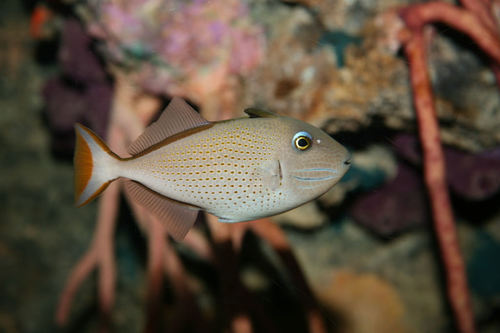
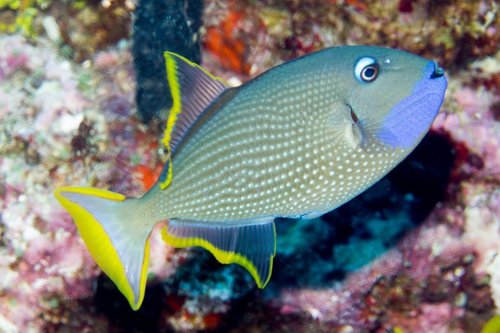
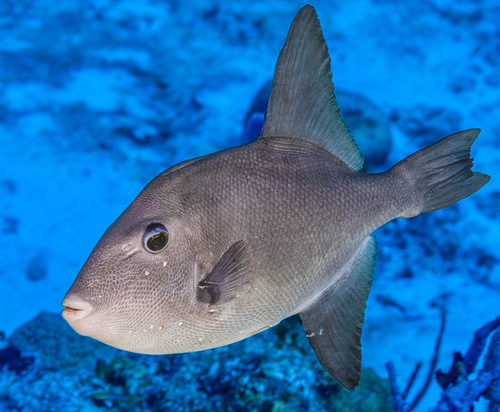
This species has a dove or ash-colored body. The original description recorded a body length of 14 inches and depth of 5 inches, excluding the dorsal fin. The dorsal fin can be collapsed into a furrow along its supporting spine. The three spines of the first dorsal fin resemble the lock of a gun: the rostral spine acts as the gun cock, and the caudal spine acts as the trigger. Canthidermis sufflamen has large, light brown eyes, and often has darker patches at the bases of its pectoral fins and between its dorsal and anal fins. The darkness of the pectoral fin base spot varies between individuals from different geographic regions.
Meristic data from a 2003 NOAA Technical Memorandum for this ocean triggerfish records a total of 18 vertebrae: 7 precaudal and 11 caudal. The first dorsal fin has three spines; the second dorsal fin has 25 to 28 rays, with a mode of 27. The anal fin has 23 to 25 rays, with a mode of 24. Each pectoral fin has 15 or 16 rays, with a mode of 15. The caudal fin has 12 rays. The pelvic fin of this species is rudimentary, reduced to a single rayless tubercle.
The ocean triggerfish has a broad distribution, and is a common to uncommon resident of waters off Florida, the Bahamas, and the Caribbean islands. Its range reaches as far north as Massachusetts, as far south as Brazil, west to the Gulf of Mexico, and east to Bermuda and the Portuguese island of Madeira. These fish typically occur in open water, far above coral reefs and often near sharp drop-offs. Females lay eggs in sandy areas and stay near their nests to defend them from predators.