About Canthidermis maculata (Bloch, 1786)
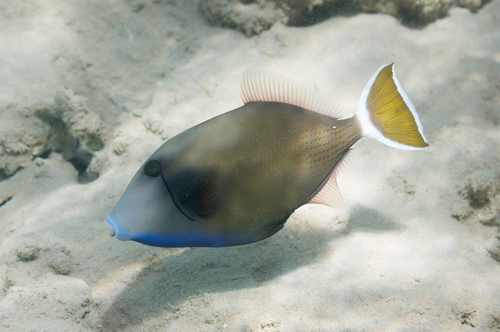
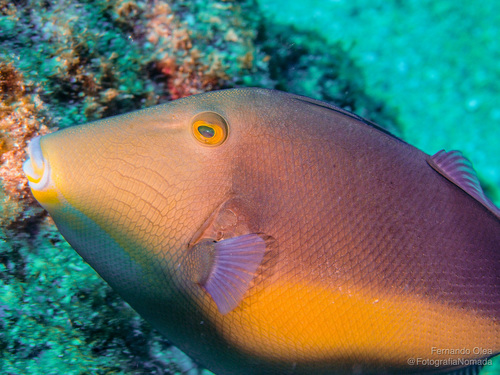
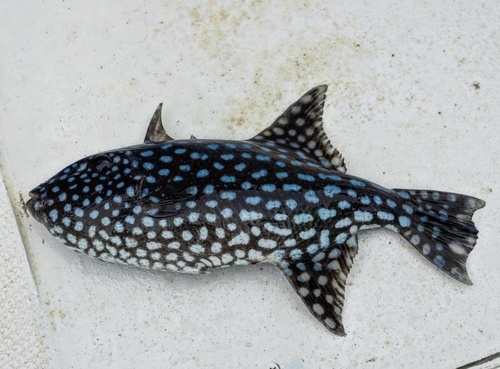
Canthidermis maculata, commonly known as the spotted oceanic triggerfish, reaches a maximum total length of 50 centimetres (20 in), though most individuals only grow to 35 centimetres (14 in). Adults and juveniles of this species differ in coloration: adults are blue-gray, while juveniles are gray-black with white spots that fade as the fish ages. During mating, adults may develop dark blotches on the face and pectoral fins. These same markings appear on females hovering above their nests, and can disappear within a few seconds once the female swims upward through the water column away from the nest (Clark et al., 2014).
The dorsal and anal fins of this species curve backward. The dorsal fin has 23 to 27 rays total; the rays of the first dorsal fin are spinous, with the first two modified into sharp thorns. The smaller second thorn props up the longer first thorn, creating a trigger-like structure that gives triggerfish their common name (Tupongov, 2015). The anal fin has 20 to 27 rays. Adults and juveniles also differ in caudal fin shape: juveniles have rounded caudal fins, while adults have concave caudal fins.
This species has a wide distribution across the world's tropical and warm temperate oceans. In the western Pacific Ocean, its range extends from the Gulf of Thailand north to the Yellow Sea and Japan, and eastward to the Philippines, Indonesia, Polynesia, and Hawaii. In the eastern Pacific Ocean, it occurs from Mexico and the Gulf of California south to Peru and the Galapagos Islands. Across the Indian Ocean, it ranges from the Red Sea and eastern Africa to the Seychelles, the Maldives, the Persian Gulf, India, Sri Lanka, the Andaman Sea, Australia, and Indonesia. In the western Atlantic Ocean, populations range from New York south through the Gulf of Mexico, the Bahamas, and the Caribbean Sea to Brazil. In the eastern Atlantic Ocean, it occurs from the British Isles and the Bay of Biscay south to the Azores, the Canary Islands, and western Africa, with additional populations found off South Africa.
The spotted oceanic triggerfish lives in warm, biodiverse waters characterized by strong surface currents and upwelling systems (Lezama-Ochoa et al., 2016). It can be found on offshore deep slopes, in open water (Matsuura, 2001), and around fish aggregating devices (FADs), where groups of hundreds to thousands of individuals have been observed (Taquet et al., 2007).
In terms of ecology, Canthidermis maculata is a documented host of sea lice (Copepoda: Caligidae) in the Neotropical region (Morales-Serna et al., 2016). It has also been recorded visiting cleaning stations hosted by the black-nosed butterflyfish and the Mexican hogfish at Malpelo Island in the tropical eastern Pacific (Quimbayo et al., 2016).