About Cantharidella picturata (A.Adams & Angas, 1864)
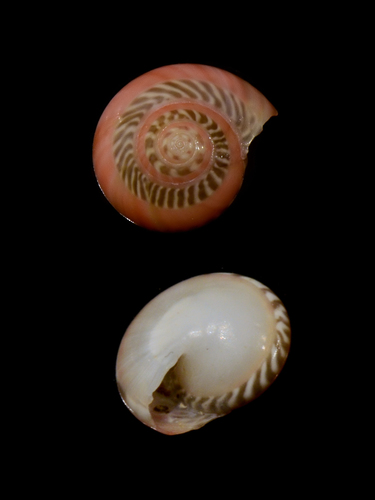
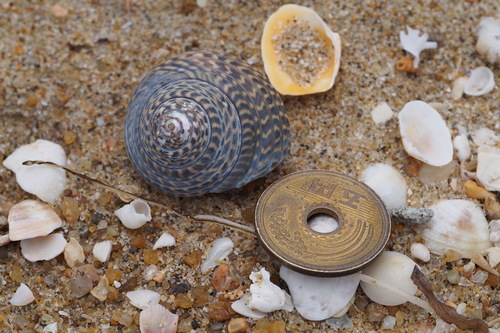
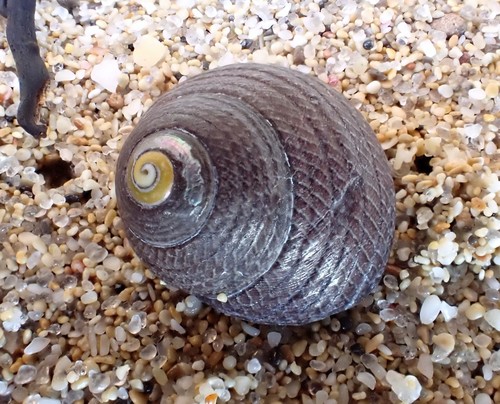
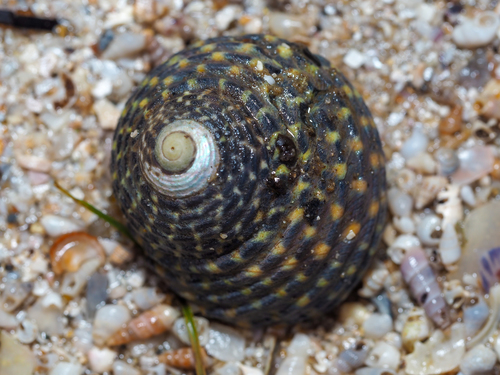
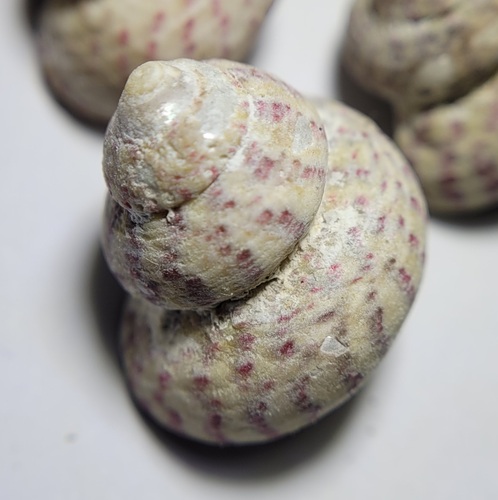
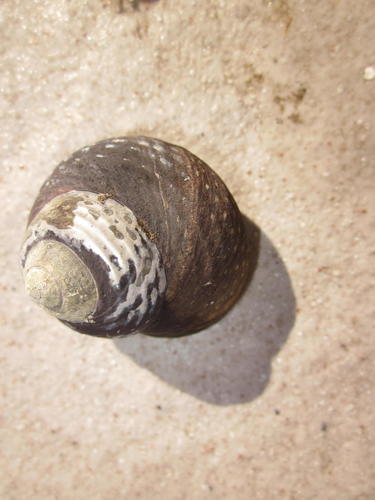
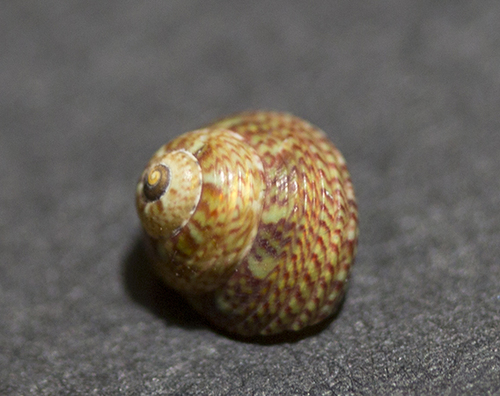
The shell of Cantharidella picturata ranges between 4 mm and 8 mm in size. This small, narrowly umbilicate shell has a conical shape, and is extremely variable in coloration. The most common color patterns are as follows: Whitish shells with broad or narrow longitudinal red or crimson streaks that reach the periphery, with the ground color and base dotted with red. These streaks are often interrupted in the middle by a dotted zone. For other individuals, the ground color is pale yellowish or whitish, with spiral lirae dotted with red; this pattern often has short red streaks just below the sutures. A third common variant has an entirely purplish black shell surface, with a green-tinged umbilicus. All variants except the purplish black one have a whitish area around the umbilicus. In all variants, the inside of the umbilicus and the columella are tinged with green. The spire is elevated, conical, and rather obtuse, with impressed sutures. The shell has five to six convex whorls, which are encircled by spiral lirae; there are usually 5 or 6 lirae on the penultimate whorl, but this number is very variable. The body whorl has a prominent rib at the periphery, and is convex on its underside. The aperture is quadrangular, with fine ribbing on the inside, and is iridescent with green as the dominant color. The columella is arcuate near the top, then becomes straight and oblique, ending in a small denticle near the base. This is a beautiful small species, usually either marked with dark red streaks or entirely dotted with pink. The ground color may sometimes have a green tint, or be pink itself. This marine species is endemic to Australia, where it is found off the coasts of Queensland, New South Wales, Victoria and Tasmania.