About Cantharellus subalbidus A.H.Sm. & Morse
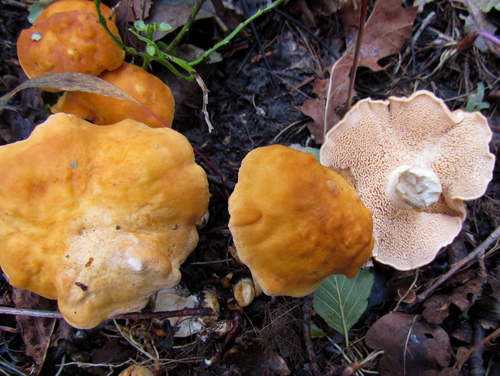
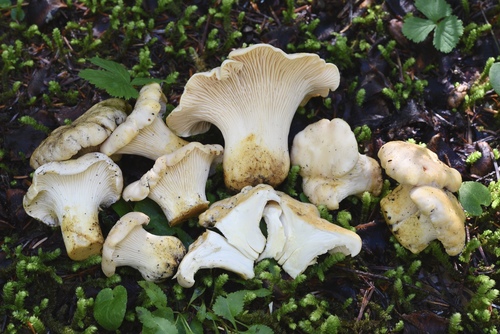
This fungus, Cantharellus subalbidus, is white to cream in color, and darkens to yellow-orange as it matures. Its cap measures 4–15 centimetres (1.5–6 inches) wide, starting flat to depressed and becoming infundibuliform, or vaselike, with age. The stalk is 2–7 cm (3⁄4–2+3⁄4 inches) tall and 1–5 cm wide, it is tapered and develops yellow-brown spots from bruising and aging. Its spores are white, elliptical, and smooth. It looks similar to other chanterelle species, but can be distinguished by its cream to white color and orange bruising. C. subalbidus is native to California and the Pacific Northwest region of North America. In the Pacific Northwest, it can be found from August to October. This fungus is more common in old-growth forests than in younger forests. Cantharellus subalbidus may form mycorrhizal associations with pine, hemlock, Douglas-fir, and Pacific madrone species. It is a choice edible mushroom. Preparation methods include sautéing, or cutting it into chunks and baking at 350 °F (177 °C) for 10 minutes.