About Cantao ocellatus (Thunberg, 1784)
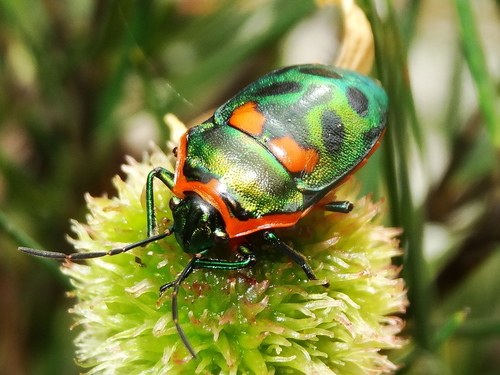
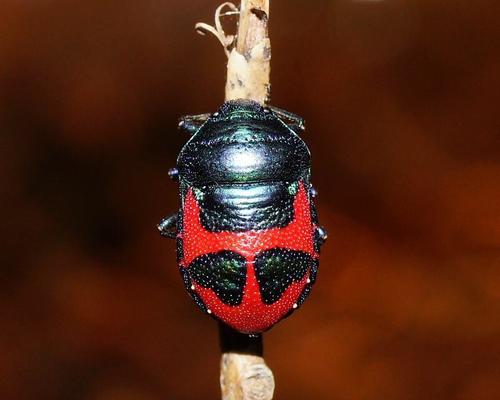
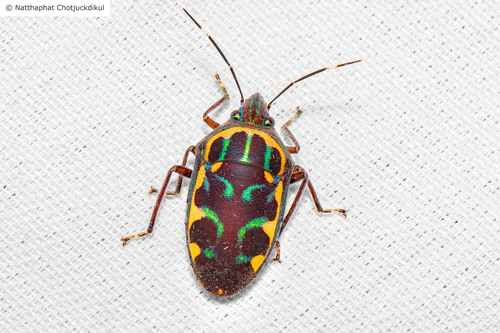
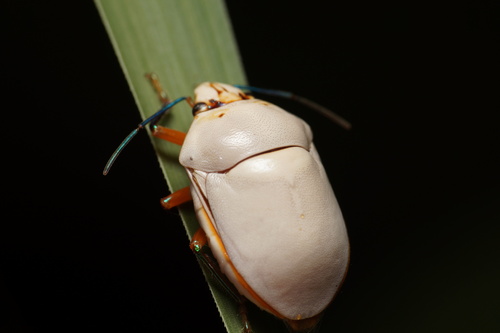
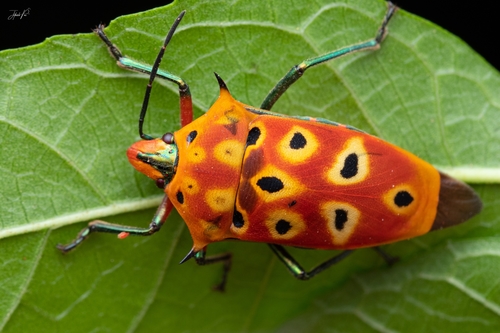
Cantao ocellatus is generally reddish or ochre overall, with dark legs and bluish black antennae. A dark bluish black stripe runs along the central line of its head. The pronotum may have either two black spots on its front margin, or eight black spots. Its scutellum carries eight or six black spots of varying size, each with a yellowish border. The lateral angle of the pronotum extends into a curved spine, though this spine may be much reduced in some individuals. A distinctive symbiotic bacterial genus Sodalis, belonging to the phylum Gammaproteobacteria, lives in the midgut of this species. This species has been recorded demonstrating maternal care of eggs and nymphs. After laying eggs, the female stands over and covers them; however, edge eggs that the female cannot cover are often parasitized by wasps. Cantao ocellatus has been reported across a range that extends from the Indian Subcontinent through Southeast Asia to Papua New Guinea, and it has also been recorded in Japan and Zaire. In terms of behaviour and ecology, Cantao ocellatus sucks sap from a wide variety of host plants, including Macaranga, Camellia sasanqua, Kigelia, Mallotus, Bischofia javanica, and Broussonetia papyrifera.