About Canna indica L.
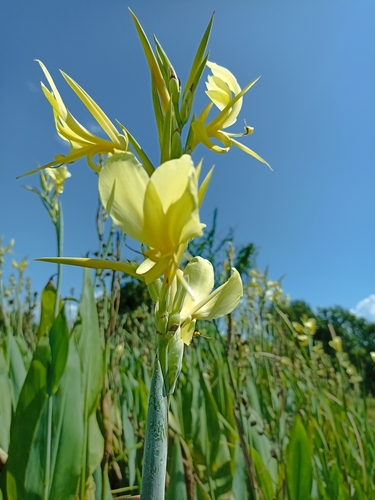
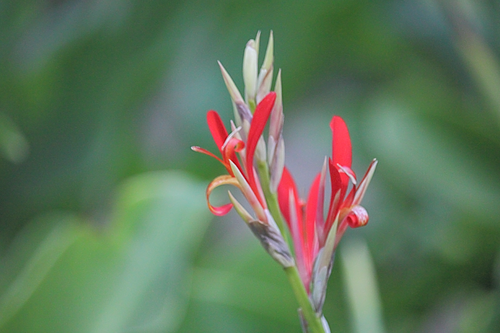
Canna indica L. is a perennial plant that reaches 0.5 to 2.5 metres (1 1/2 to 8 feet) tall, with size varying by variety. It is hardy to zone 10 and sensitive to frost. Plants grow an upright, unbranched stem, or overlapping leaf sheaths form a false trunk. It produces branched rhizomes up to 60 centimetres (24 inches) long; these are divided into bulbous segments, covered in two rows of pale green or purple flaky scale leaves. Transverse grooves mark the rhizome surface, each marking the base of one covering scale. White rootlets grow from the lower part of the rhizome, and numerous buds are present at the apex, which produce new leaves, floral stems and vegetative stems. The very large starch grains in this plant can reportedly be seen with the naked eye.
Its very large, simple leaves are arranged alternately in a spiral or two-row pattern. Each leaf is divided into a leaf sheath, short petiole, and leaf blade. The leaf blade measures 30 to 60 cm (12 to 24 in) long and 10 to 20 cm (4 to 8 in) wide. Parallel leaf veins branch from the midrib, which is not a typical trait for monocots. Leaves are broad, green or violet-green, with elliptical blades that can reach 30 to 60 cm long and 10 to 25 cm wide. The leaf base is obtuse or narrowly cuneate, and the leaf apex is shortly acuminate or sharp.
Canna indica is native to most of South America including Colombia, Venezuela, Ecuador, Peru, Brazil, Uruguay and Argentina, as well as the West Indies and Central America. In modern times it has also become naturalized in the southeastern United States (Florida, Texas, Louisiana, and South Carolina), most of Europe, sub-Saharan Africa, Southeast Asia, and Oceania. It is specifically reported as naturalized in Austria, Portugal, Spain, the Azores, Canary Islands, Cape Verde, Madeira, most of tropical Africa, Ascension Island, St. Helena, Madagascar, China, Japan, Taiwan, the Bonin Islands, India, Nepal, Sri Lanka, Cambodia, Laos, Thailand, Vietnam, Burma, Java, Malaysia, the Philippines, Christmas Island, the Bismarck Archipelago, Norfolk Island, New South Wales, Queensland, Fiji, Tonga, Vanuatu, Kiribati, the Cook Islands, the Society Islands, the Caroline Islands and Hawaii.
This species can be cultivated from sea level up to 2,700 m (8,900 ft) above sea level. It grows best in temperate, tropical or subtropical mountain climates, at elevations between 1,000 and 2,000 m (3,300 and 6,600 ft) above sea level (it grows at higher elevations in humid tropical climates), with a mean temperature of 14 to 27 °C. It prefers an mean annual rainfall between 1,000 and 4,500 millimetres, but can tolerate between 500 and 5,000 mm per year. It grows best in light sandy-loamy soils, but can also grow on heavy soils as long as the soil is not waterlogged. It is not affected by soil pH. For seeds to germinate, they must be soaked in water for two to three days.
Canna indica, also called achira, has been cultivated by indigenous peoples of the Americas in tropical America for thousands of years. The first domestication likely occurred in the northern Andes, similar to other related root crops like Calathea allouia and M. arundinacea. The Cauca River valley of Colombia was an early center of domestication. Archaeological evidence shows achira was cultivated as early as 3000 BCE by people of the Las Vegas culture of coastal Ecuador. Since the Las Vegas region is arid and semiarid, achira was probably not native to the area and was imported from more humid climates. By 2000 BCE, achira was also cultivated by people of the Casma/Sechin culture in the extremely arid coastal region of Peru, another area where achira was probably not native.
In some regions, Canna indica leaves are used as feed for livestock. Its seeds are widely used to make jewellery: they are often pierced and used as imitation pearls. They are also used as filling for rattles, including the kayamb, a musical instrument from Réunion, and the hosho, a gourd rattle from Zimbabwe where the seeds are called "hota" seeds. Historically, indigenous peoples used the seeds as gold weights, similar to carob (Ceratonia siliqua) seeds, because Canna indica seeds have a consistent weight. According to the BBC, during the 19th century Indian Mutiny, soldiers used Canna indica seeds as a substitute when they ran out of bullets. Canna indica can be used to treat industrial wastewater in constructed wetlands. It is effective at removing high organic loads, colour, and chlorinated organic compounds from paper mill wastewater. In China, starch from this plant and polyethylene are used as raw materials to produce affordable biodegradable plastics. These plastics can degrade completely into crop fertilizer in just a few months. The production method fuses 60–80% Canna indica starch and 20–40% polyethylene uniformly at 240 °C.