About Canis lupaster Hemprich & Ehrenberg, 1833
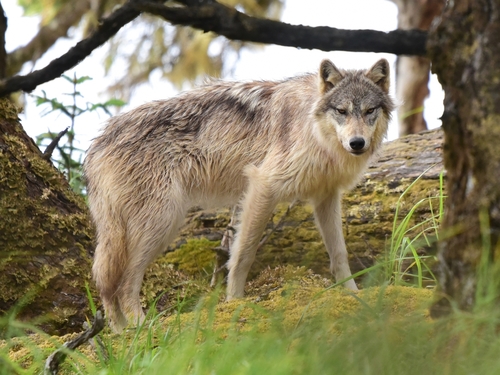
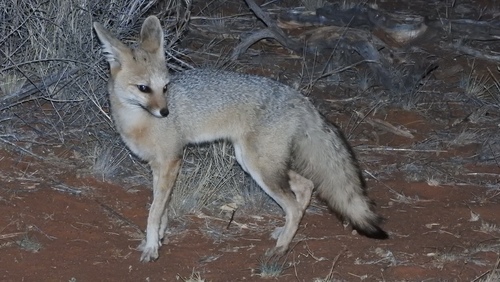
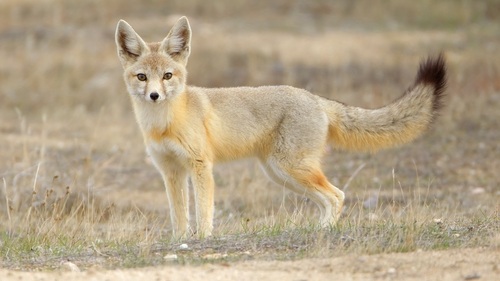
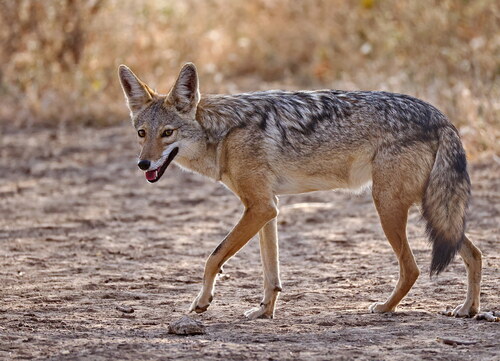
The African wolf (Canis lupaster Hemprich & Ehrenberg, 1833) is intermediate in size between African jackals (Lupulella mesomelas and Lupulella adusta) and small gray wolf subspecies. Both sexes weigh 7–15 kg (15–33 lb), and stand 40 cm (16 in) tall. There is substantial geographic size variation: specimens from Western and Northern Africa are larger than those from East Africa. It has a relatively long snout, long ears, and a comparatively short tail that measures 20 cm (7.9 in) in length. Fur color varies individually, seasonally, and geographically. The typical coloration ranges from yellowish to silvery grey, with slightly reddish limbs and black speckling on the tail and shoulders. The throat, abdomen, and facial markings are usually white, and the eyes are amber-colored. Females have two to four pairs of teats. While it is superficially similar to the golden jackal, especially in East Africa, the African wolf has a more pointed muzzle, sharper more robust teeth, longer ears, and a skull with a more elevated forehead.
Canis lupaster has a wide range across the northern half of Africa, where it is confirmed to occur in Senegal, Burkina Faso, Cameroon, the Central African Republic, Djibouti, Eritrea, Ethiopia, Guinea, Mali, Mauritania, Niger, Somalia, South Sudan, Sudan, Western Sahara, Nigeria, Chad, Morocco, Algeria, Tunisia, Libya, Kenya, Egypt, and Tanzania. Pleistocene fossil finds show the species' range was not always restricted to Africa, with fossil remains found in the Levant and Saudi Arabia. In Tanzania, the African wolf is limited to a small area of the north between the western slopes of Mount Kilimanjaro and the centre of the Serengeti. Within this region, it occurs mostly in the short-grass plains, the floor of Ngorongoro Crater, and the plains between the Olmoti and Empakai Craters, and it is relatively rare in Serengeti National Park, Loliondo, and the Maswa game reserve. The species also inhabits the Lake Natron area and West Kilimanjaro. It is sometimes found in the northern part of Arusha National Park, and occurs as far south as Manyara. In areas where it is common, such as the short-grass plains of Serengeti National Park and the Ngorongoro Crater, population densities range between 0.5 and 1.5 specimens per km². A 60% population decrease has been recorded in the southern plains of Serengeti National Park since the early 1970s, though the reasons for this decline are unknown.
The African wolf inhabits many different habitat types. In Algeria it lives in Mediterranean, coastal, and hilly areas, including hedged farmlands, scrublands, pinewoods, and oak forests. Populations in Senegal occupy tropical, semi-arid climate zones including Sahelian savannahs. Wolf populations in Mali have been documented in arid Sahelian massifs. In Egypt, the African wolf inhabits agricultural areas, wastelands, desert margins, rocky areas, and cliffs, and lives close to the lakeshore at Lake Nasser. In 2012, African wolves were photographed in Morocco's Azilal Province at an elevation of 1,800 meters. The species apparently does well in areas with high human density and low natural prey populations, as seen in the Enderta district in northern Ethiopia. This wolf has also been reported in the very dry Danakil Depression desert on the coast of Eritrea, eastern Africa.