About Cancer pagurus Linnaeus, 1758
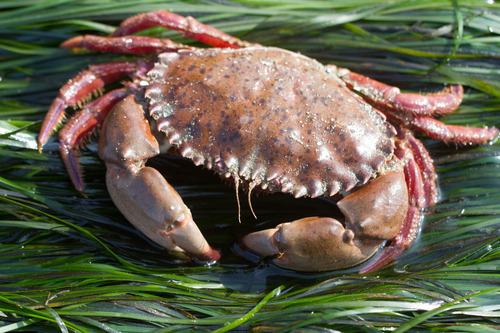
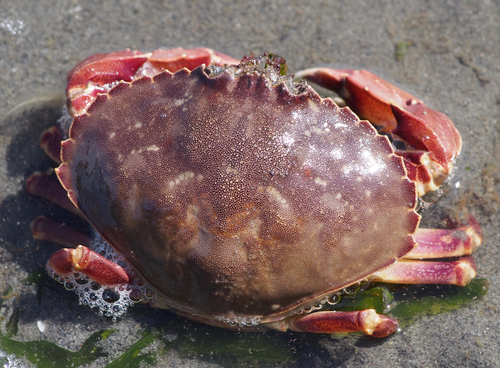
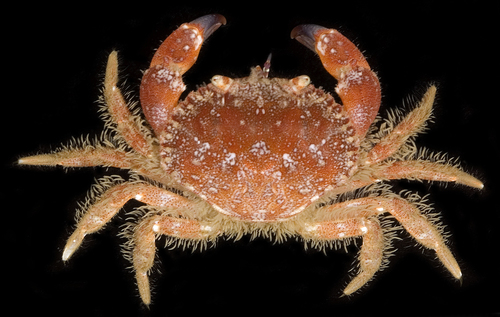
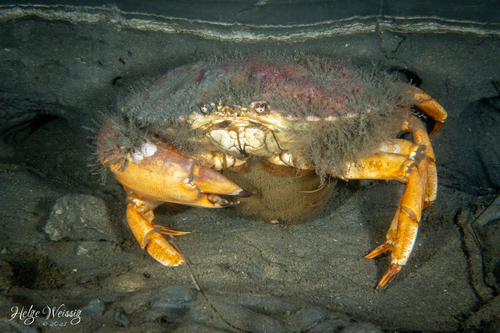
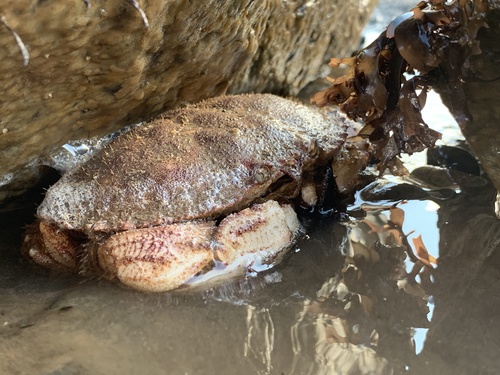
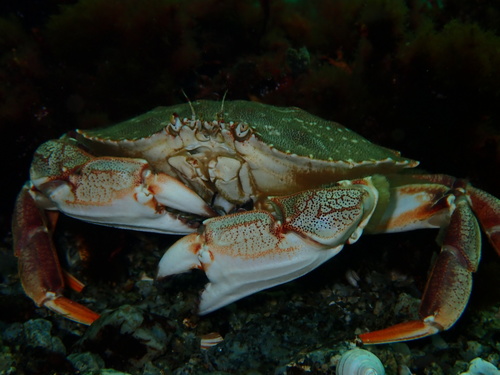
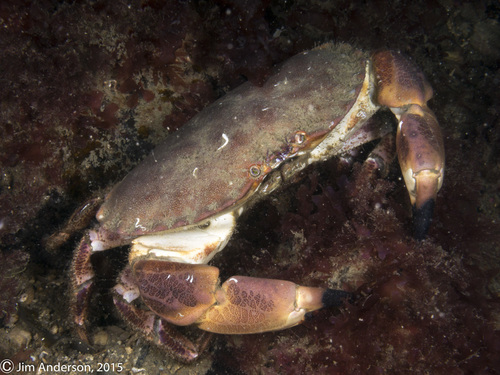
Cancer pagurus, described by Linnaeus in 1758, has distinct coloration based on age: adult carapaces are reddish-brown, while young specimens have purple-brown carapaces. White patches occasionally appear on the carapace, and its front edge is shaped into nine rounded lobes that resemble a pie crust. Typically, males have a carapace 60 mm (2+1⁄4 in) long, and females have a carapace 98 mm (3+3⁄4 in) long, though exceptional individuals can reach 150 mm (6 in) in carapace length. Carapace width is typically 150 mm (6 in), and can reach up to 250 mm (9+3⁄4 in) in exceptional cases. A ventral fold of the carapace forms the branchial chamber that holds the gills. The first pereiopod is modified into a strong cheliped, or claw-bearing leg; the claw's fingers, called the dactylus and propodus, have black tips. The remaining pereiopods are covered in rows of short, stiff setae, and each has a black-tipped dactylus that ends in a sharp point. When viewed from the front, the antennae and antennules are visible, alongside the orbits that house the eyes. The mouthparts consist of three pairs of maxillipeds, followed behind by a pair of maxillae, a pair of maxillules, and finally the mandibles. This species is abundant across the northeast Atlantic, ranging north to Norway and south to North Africa. It lives on mixed coarse grounds, mud, and sand from the shallow sublittoral down to around 100 m (300 ft; 50 fathoms) deep. It is commonly found in rock cracks and holes, though it occasionally occurs in open areas. Smaller individuals may be found under rocks in the littoral zone. There are unconfirmed reports of this species occurring in the Mediterranean Sea and Black Sea. Adult C. pagurus are nocturnal: they hide buried in substrate during the day, and forage up to 50 m (150 ft) from their hideouts at night. Their diet includes a wide range of crustaceans (such as the crabs Carcinus maenas and Pilumnus hirtellus, porcelain crabs Porcellana platycheles and Pisidia longicornis, and squat lobster Galathea squamifera) and molluscs (including gastropods Nucella lapillus and Littorina littorea, and bivalves Ensis, Mytilus edulis, Cerastoderma edule, Ostrea edulis, and Lutraria lutraria). C. pagurus may either stalk or ambush mobile prey, and dig large pits to reach buried molluscs. Octopuses are the main predator of C. pagurus, and will even attack the crabs inside fishermen's crab pots. Reproduction for C. pagurus takes place in winter. The male stands over the female and forms a protective cage around her with his legs while she moults. Internal fertilisation occurs before the female's new carapace hardens, and is carried out with the help of two abdominal appendages called gonopods. After mating, the female retreats to a pit on the sea floor to lay her eggs. She carries between 250,000 and 3,000,000 fertilised eggs under her abdomen for up to eight months until they hatch. After hatching, the first developmental stage is a 1 mm planktonic larva called a zoea, which then develops into a postlarva called a megalopa, before finally becoming a juvenile. The first juvenile stage has a well-developed abdomen that reduces in size over time and folds under the sternum. Juveniles settle on the sea floor in the intertidal zone, where they remain until they reach a carapace width of 60–70 mm (2+3⁄8–2+3⁄4 in), after which they migrate to deeper water. Before males reach 8 years old, their carapace width grows by 10 mm per year; after 8 years, this growth rate slows to 2 mm per year. Females grow at roughly half the rate of males, a difference thought to stem from the energy required for egg laying. Females reach sexual maturity at a carapace width of 127 mm (5 in), while males reach sexual maturity at 110 mm (4+3⁄8 in). C. pagurus typically lives 25 to 30 years, though rare exceptional individuals may live up to 100 years.