About Cancer borealis Stimpson, 1859
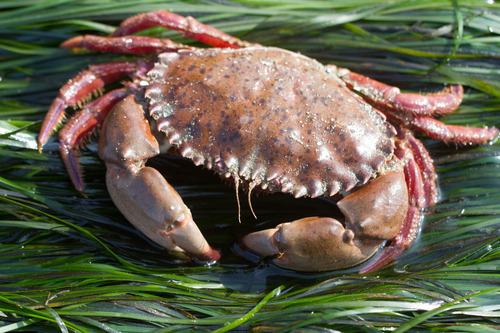
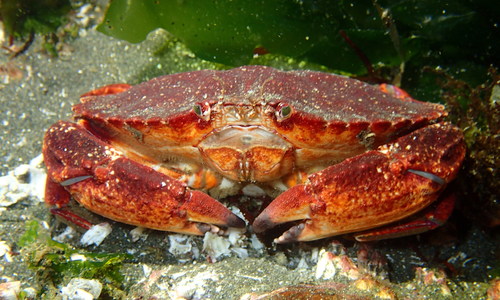
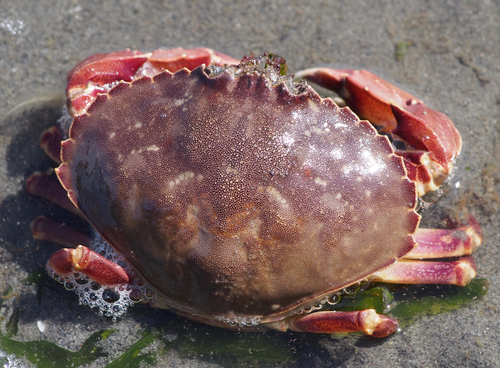
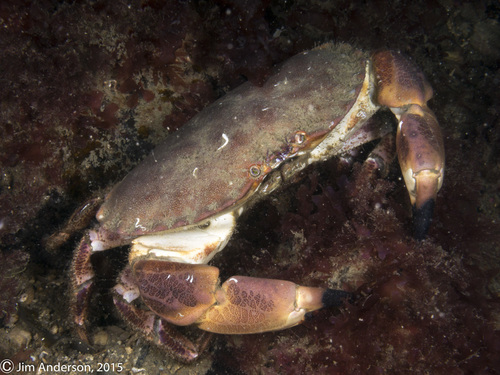
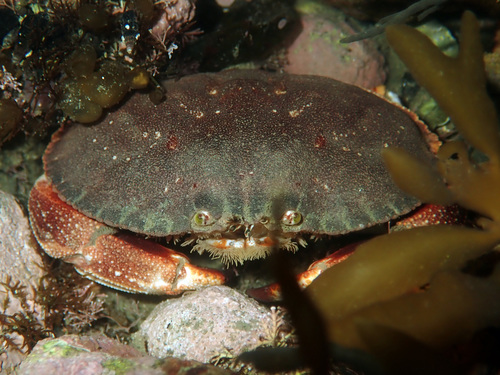
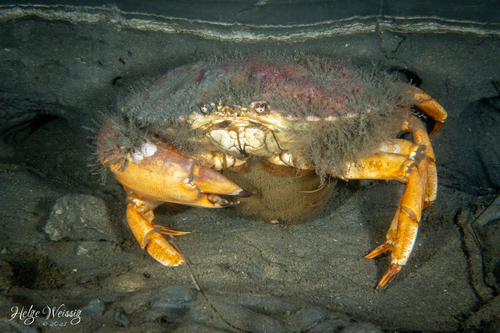
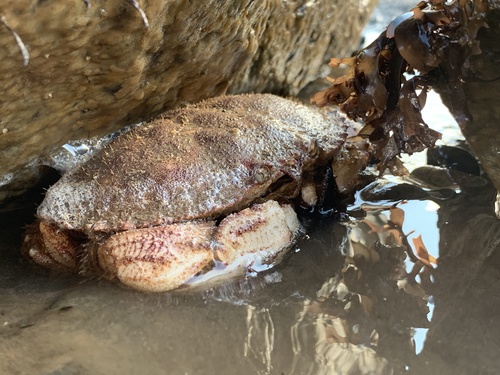
The Jonah crab, with the scientific name Cancer borealis Stimpson, 1859, is a marine brachyuran crab that lives in waters along the east coast of North America, ranging from Newfoundland to Florida. Jonah crabs have a rounded, rough-edged carapace marked with small light spots, and strong, robust claws with dark brown-black tips. The maximum recorded carapace width for male Jonah crabs is 8.7 inches (222 mm), while females almost never grow larger than 5.9 inches (150 mm). In the Western Atlantic, it is the closest living relative of the European brown crab. Jonah crabs have been found at depths as great as 2,460 feet (750 m). Their preferred habitat varies: in Rhode Island and the Gulf of Maine, they favor rocky substrate, while on the continental slope they favor silt and clay substrate. It is generally agreed that this species moves offshore during the fall and winter, and female Jonah crabs have been recorded moving inshore during late spring and summer. The Jonah crab moves to areas with its preferred temperature to perform behavioral thermoregulation. Its preferred temperature changes based on the temperature it has been acclimated to, and the estimated average preferred temperature is 59.7 °F (15.4 °C). Since Jonah crabs are a strongly preferred prey of gulls, their survival rate is highest in deep water. Even so, some crabs will go to shallower depths and the intertidal zone to forage, where food is more plentiful. Because crabs that forage in shallow depths have a faster growth rate, and crabs that forage in deep water have higher survival, both foraging behaviors have roughly equal impact on fitness. Unlike smaller, more agile blue crabs and rock crabs, the predation style of Jonah crabs has been compared to that of lobsters—they rely on brute crushing force to hunt. This allows them to feed on large mussels and periwinkles that other predators living in the same area cannot access. Before reaching a carapace width of 1.2–1.6 inches (30–40 mm), which is approximately the size of gonadal sexual maturity, males and females grow at around the same rate. After reaching this size, females grow more slowly than males. Males usually reach gonadal maturity at a smaller size than females, but only become functionally sexually mature at around 5.02 inches (127.6 mm), when they are able to perform the copulatory embrace. For populations of Jonah crabs living at higher latitudes, the size at gonadal maturity is larger. A study conducted in Rhode Island Sound found that smaller male Jonah crabs (with a carapace width less than 4.7 inches / 120 mm) have a distinct molting season in June. With each consecutive molt, the increase in carapace width after molting gets smaller for female crabs and larger for male crabs. In Rhode Island Sound, male crabs with a carapace width larger than 4.7 inches (120 mm) rarely molt. It is possible that Jonah crabs migrate away from the area before growing to this size, as larger crabs are more commonly found further offshore. Mating happens after females undergo ecdysis, and females can store sperm indefinitely. Spawning typically occurs in inshore waters. The spawning season happens later in the year for populations at higher latitudes: it takes place in early spring in the Mid-Atlantic Bight, and in the fall in Maine. Females brood eggs for 5 to 6 months before the eggs hatch. After spending a period of time in plankton as zoea, the megalopa stage settles in the subtidal zone, and shows no clear preference for either cobble or sand substrate.