About Canavalia cathartica Thouars
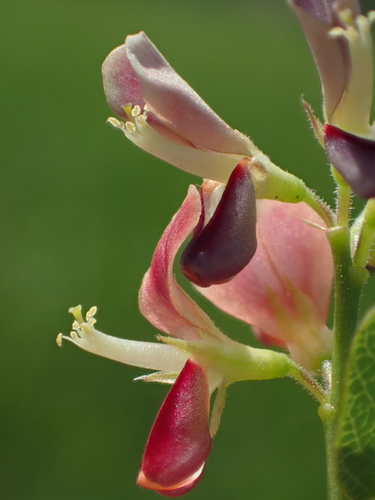
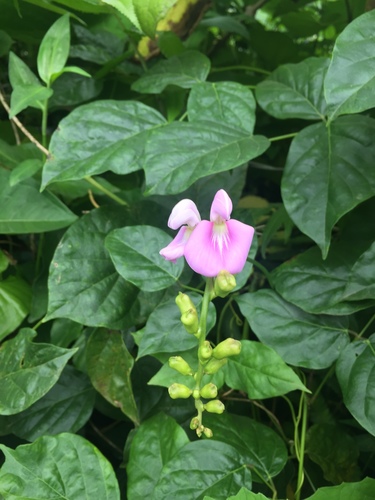
Canavalia cathartica Thouars is a biennial or perennial herb with thick, twining climbing stems. Its pinnate leaves are each composed of three papery leaflets, which are typically oval in shape with either pointed or rounded tips. Leaflets can grow up to 20 centimeters (7.9 inches) long and 14 centimeters (5.5 inches) wide, though they are usually smaller. Its inflorescence is a raceme or pseudoraceme that holds several flowers. Each flower has a bell-shaped calyx of sepals divided into two lips: an upper lip with two lobes and a lower lip with three teeth. The flower corolla is pink or purplish, with a standard petal marked by white spots. It also has two wing petals and two keel petals, each roughly 3 centimeters (1.2 inches) long. The fruit of this species is an inflated, turgid legume pod that reaches up to 13.5 centimeters (5.3 inches) long and 4.5 centimeters (1.8 inches) wide; fresh mature pods can weigh over 32 grams (1.1 ounces). The hard, smooth seeds are reddish brown, darkening to deeper brown as they mature, and measure nearly 2 centimeters (0.8 inches) long by 1 centimeter (0.4 inches) wide. In India, this plant grows in mangroves. Its seeds float on water, wash onto coastal sand dunes, and germinate to establish new plants there. It grows in a mat-forming habit that binds sand to prevent erosion. This legume supports a diverse community of associated microbes, including nodal rhizobia, arbuscular mycorrhizae, and a variety of endophytic fungi. Common arbuscular fungal associates include the glomeromycetes Gigaspora albida, Acaulospora spinosa, and several Glomus species such as G. aggregatum. Microbial surveys have documented many endophytes in this plant, with different community assemblages in different habitat types. The ascomycete Chaetomium globosum lives in the plant’s roots; it also hosts Colletotrichum dematium, Aspergillus niger, A. flavus, Fusarium oxysporum, and Penicillium chrysogenum. The microbes hosted by this plant likely help it survive in harsh coastal habitats. In coastal India, the seeds and pods of Canavalia cathartica are used as famine foods. It is classified as an underutilized wild plant with potential to be developed as a food crop rich in protein and carbohydrates. It contains more protein than several other common edible legumes, including pigeon pea, chickpea, and cowpea. It grows rapidly, tolerates challenging habitats such as dry, sandy, saline soils, and appears to be relatively pest-resistant. Like many legumes, C. cathartica contains antinutrients and requires preparation or processing before human consumption. Antinutrients found in the species include phenols, tannins, and lectins such as phytohaemagglutinin. Pressure cooking can reduce levels of these antinutrients, while roasting is somewhat less effective. In small-scale agriculture, farmers use this plant as green manure and mulch, and grow it in fields for its nitrogen fixation ability. It grows easily on farmland located in its native mangrove wetland habitat. It is also used as cattle fodder, and its stems, pods, and leaves are fed to rabbits and hares. Many recent studies from India claim this species is the wild ancestor of Canavalia gladiata, citing the 1968 hardback edition or 1974 third/paperback edition of J. W. Purseglove’s Tropical Crops: Dicotyledons. In this work, Purseglove mentions that C. virosa may be the ancestor of C. gladiata; this claim is likely an error, because the name C. virosa used in the 1968 and 1974 publication refers to the modern species C. africana under the taxonomic classification in use at that time. Sauer himself proposed C. gladiolata as the ancestor of C. gladiata in the relevant article. This plant grows in Micronesia, where local island residents use it as an herbal remedy for conditions including cough. In Hawaii, where it is a non-native invasive species, its showy flowers and large seeds are used to make leis.