About Cananga odorata (Lam.) Hook.f. & Thomson
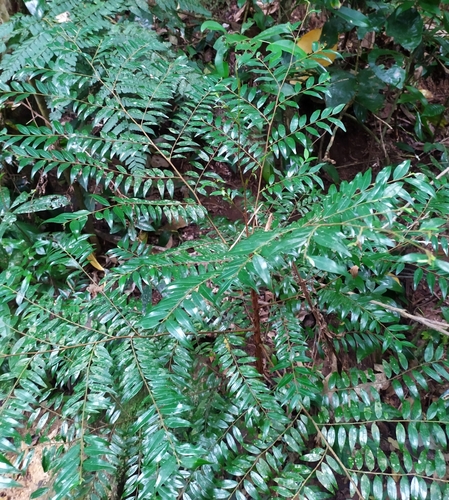
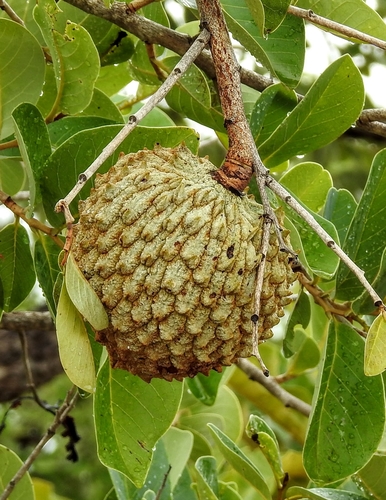
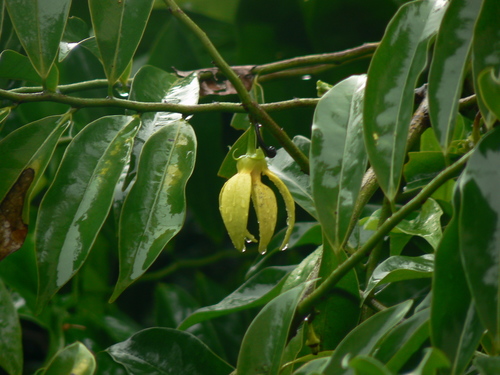
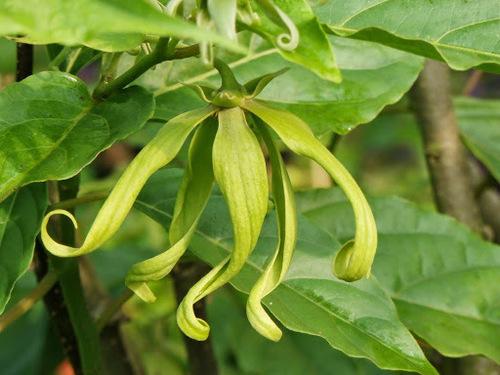
Cananga odorata (Lam.) Hook.f. & Thomson, commonly called ylang-ylang, is a fast-growing tree in the custard apple family Annonaceae. It grows more than 5 meters (16 feet) per year, and reaches an average height of 12 meters (39 feet) when grown in ideal climate conditions. It has evergreen pinnate compound leaves that are smooth, glossy, and between 13 and 21 centimeters (5 to 8.5 inches) long. Its leaflets are oval, pointed, and have wavy margins. The species produces drooping, long-stalked flowers with six narrow greenish-yellow petals; pink petals are very rare. The flowers look similar to a sea star, and produce a highly fragrant essential oil. Pollen from Cananga odorata is released as permanent tetrads. A dwarf variety, Cananga odorata var. fruticosa (dwarf ylang-ylang), grows as a small tree or compact shrub. Ylang-ylang fragrance is rich and deep, with notes of rubber and custard, and bright hints of jasmine and neroli. It is often described as a heavy, sweet, slightly fruity floral scent. The essential oil is extracted from the flowers via steam distillation, and separated into different grades: extra, 1, 2, and 3, based on when the distillate is collected. The main aromatic compounds that give ylang-ylang oil its characteristic scent are benzyl acetate, linalool, p-cresyl methyl ether, and methyl benzoate. The plant is native to Maritime Southeast Asia and Near Oceania, including the Philippines, Malaysia, Indonesia, New Guinea, the Solomon Islands, and Queensland, Australia. It is also native to parts of Thailand and Vietnam. It has been introduced to other tropical regions across the Pacific Islands, South Asia, Africa, and the Americas. It is commonly cultivated in Madagascar, Polynesia, Melanesia, Micronesia, and the Comoros Islands. It grows in full or partial sun, and prefers the acidic soils found in its native rainforest habitat. Ylang-ylang can be cultivated in temperate climates in conservatory conditions. In Madagascar, it is grown in plantations that use Hewittia malabarica (L.) Suresh as a groundcover. The plant produces clusters of black fruit that are an important food source for birds, including the collared imperial pigeon, purple-tailed imperial pigeon, Zoe's imperial pigeon, superb fruit dove, pink-spotted fruit dove, coroneted fruit dove, orange-bellied fruit dove, and wompoo fruit dove. The Sulawesi red-knobbed hornbill acts as an effective seed disperser for Cananga odorata. Ylang-ylang essential oil is used in aromatherapy, and is widely used in perfumery for perfumes with oriental or floral themes, including Chanel No. 5. It blends well with most floral, fruit, and wood scents. In Indonesia, ylang-ylang flowers are placed on the beds of newlywed couples. In the Philippines, ylang-ylang flowers are strung together with sampaguita flowers to make necklaces called leis that are worn by women and used to decorate religious images. In 1998, ylang-ylang essential oil made up 29% of the Comoros' annual exports. Ylang-ylang is grown in Madagascar and its essential oils are exported globally. Ylang-ylang essential oil is one of the base ingredients of macassar oil.