About Campylorhynchus yucatanicus (Hellmayr, 1934)
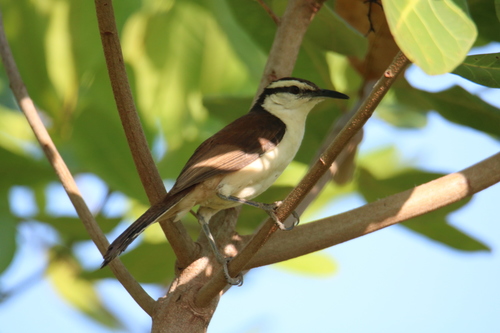
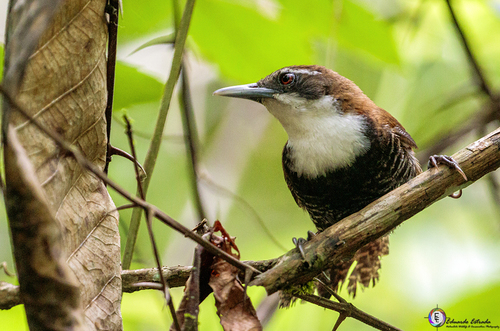
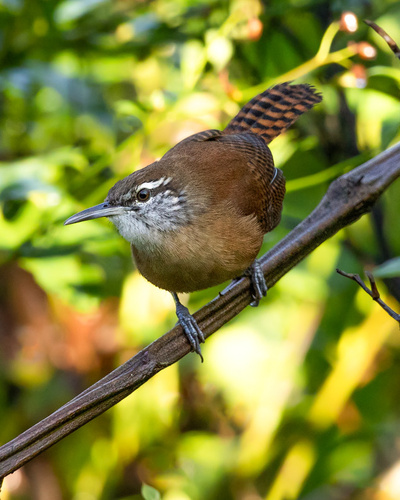
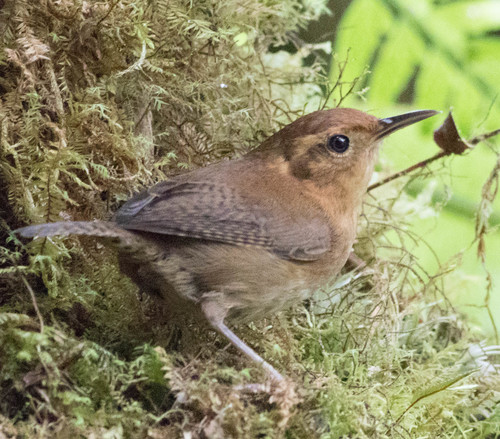
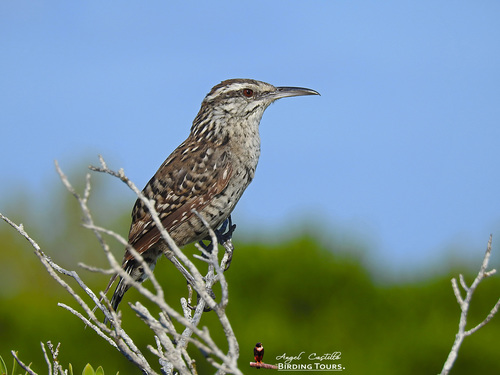
The adult Yucatan wren (Campylorhynchus yucatanicus) is a small bird, measuring approximately 18 centimeters (7 inches) in length. It has a whitish face marked by a dark eye-stripe, and a greyish brown crown. Its upper body parts are brown with black and white streaks; the wings are brown with dark brown and white barring. The tail is black with grey barring, and some outer tail feathers have white tips. Its underparts are whitish, with a dark cheek stripe and blackish spotting and barring. Juvenile Yucatan wrens look similar to adults, but have less contrast between their upper and underparts. This wren species is endemic to a coastal strip on the Yucatan peninsula. It inhabits arid areas with scrub, large cacti, and pastureland edges. Its breeding range is even more restricted, limited to a roughly one-kilometer-wide strip along the edge of coastal mangrove forests. Yucatan wrens are typically seen in pairs or small family groups, foraging among foliage and on the ground. Their diet is currently unknown. Nest building begins in April, and egg laying occurs in June. The nests are globular structures made of grass, with side entrances. They are built a few meters above the ground in coastal scrub and on the borders of coastal black mangrove (Avicennia germinans) forest. The average clutch size is three eggs, and both parents help rear the chicks. Occasionally a third adult has been observed feeding chicks, an example of cooperative breeding.