About Campylorhynchus turdinus (Wied-Neuwied, 1821)
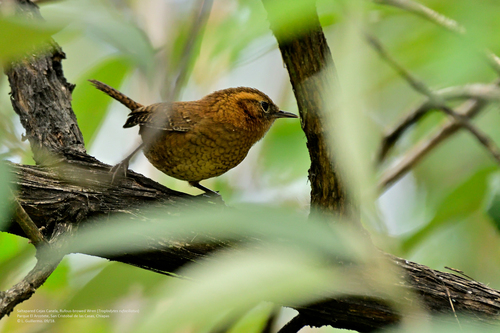
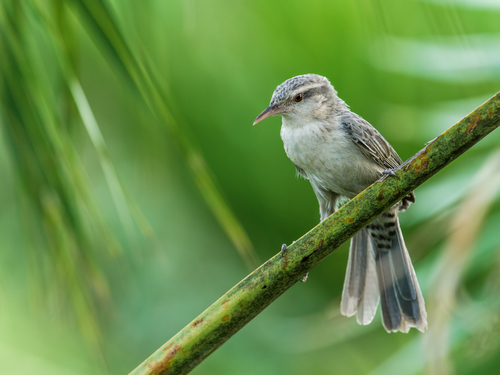
The thrush-like wren, scientific name Campylorhynchus turdinus, is a South American wren species that belongs to the wren family Troglodytidae. As both its common name and scientific name suggest, its size and coloration are vaguely similar to that of a thrush. However, when seen alive, it gives an overall impression that is very different, and not at all thrush-like. This species reaches a total length of approximately 20 cm (8 in), making it one of the largest wren species. Its head and mantle are brownish-gray. Its wings and upper tail are dull brown, marked with dense blackish barring. Its whitish underparts are heavily spotted with dusky coloration, with the only exception being the throat. It typically has a distinctive whitish eyebrow stripe, and its relatively long tail is commonly held in a cocked position. Its bill is slightly decurved, relatively long, and unusually thick for a wren. Its irides are dull amber, maroon, or brown. Unlike most other wrens, the thrush-like wren is typically found between the mid-levels and canopy height of forests. Despite its relatively large size, it is fairly inconspicuous, and is most often noticed only by its loud, complex, highly characteristic voice. It feeds primarily on insects, but will also consume vegetable matter and small invertebrates. It typically forages in pairs or small groups. Three main subspecies of the thrush-like wren exist, each restricted to its own separate main region across South America. The subspecies C. turdinus hypostictus occurs in the southern and western Amazon rainforest, distributed across southeastern Colombia, eastern Ecuador, eastern Peru, northern Bolivia, and Amazonian Brazil south of the Amazon River. The subspecies C. t. unicolor is paler, greyer, and much more uniformly colored than the other subspecies; it lives in drier, more open wooded habitats in the Brazilian Pantanal, eastern Bolivia, Paraguay, and far northern Argentina, where its range is currently expanding. The nominate subspecies, C. t. turdinus, matches C. t. hypostictus in both habitat preference and morphology. It is found in the narrow coastal belt of Atlantic moist forests in eastern Brazil, ranging from near Salvador da Bahia in the north to Espírito Santo in the south. The thrush-like wren is relatively common across most of its range.