About Campylorhynchus jocosus P.L.Sclater, 1860
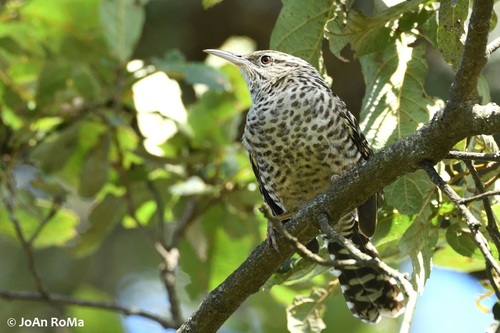
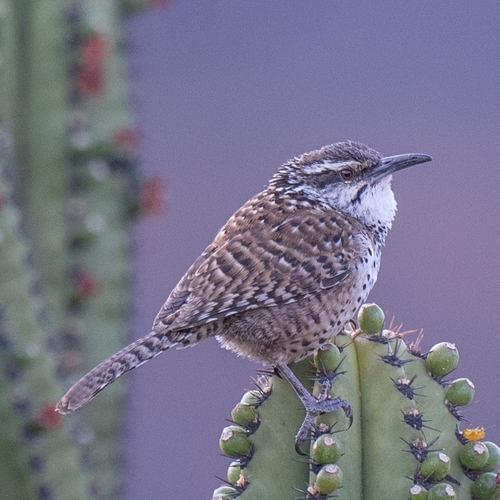
Boucard's wren (scientific name: Campylorhynchus jocosus P.L.Sclater, 1860) has an adult body length of 17 cm (6.7 in), and weighs between 23.8 to 29.8 g (0.84 to 1.05 oz). Adult males have a chocolate-colored crown, reddish nape, and blackish shoulders marked with white streaks. Their back is reddish-brown with black and white spots, and their rump is dull reddish. Their tail is gray-brown with dark brown bars, and the outermost tail feathers have white tips. Males have a dull white supercilium, a blackish eyestripe, and the rest of their face is dark gray. Their chin and throat are plain unmarked white, and their underparts are white with black spots. Their flanks are buff-colored with darker bars. Females have a similar appearance to males, differing only by having smaller spots on the underparts. Juvenile Boucard's wrens have less sharply defined markings on the back than adults; their throats are speckled, and their underparts are grayish with dull, diffuse spots. Boucard's wren is distributed in south-central Mexico, specifically in the states of Puebla, Morelos, Guerrero, and Oaxaca. It inhabits dry to arid forest that sometimes contains giant cacti; common habitat types include pine–oak woodland, oak scrub, and subtropical scrub. The species is very tolerant of habitat disturbance. Most individuals are found at elevations ranging from 800 to 2,500 m (2,600 to 8,200 ft), though it can also occur as low as 600 m (2,000 ft).