About Campylorhynchus gularis P.L.Sclater, 1861
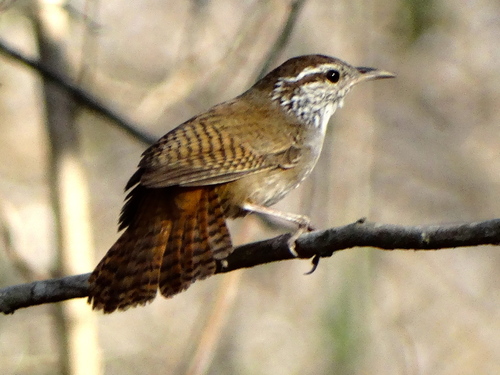
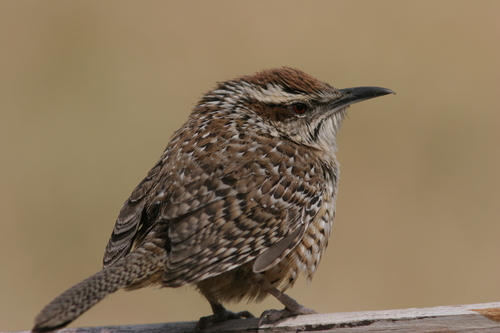
The spotted wren (Campylorhynchus gularis P.L.Sclater, 1861) measures 17 cm (6.7 in) long and weighs between 28.3 and 31 g (1.00 to 1.09 oz). Adult individuals of both sexes have a chestnut crown, and rufescent brown shoulders and back marked with dull black and buffy patterns. Their tail is gray-brown with darker bars. Adults have a white supercilium, a brown eyestripe, and buffy white cheeks. Their chin, throat, and chest are off-white, with blackish spots on the sides of the chest. The belly and lower flanks are buffy with faint barring. Juvenile spotted wrens have a dull black crown, fainter back markings than adults, and a pale buff chest without the blackish spots that adult birds have. The spotted wren is found in two separate regions of Mexico, divided by unsuitable habitat. In western Mexico, its range extends from southeastern Sonora south to western México state and western Morelos. East of the western range, it occurs from southern Nuevo León, southwestern Tamaulipas, and central San Luis Potosí south to Hidalgo. The species inhabits multiple habitat types, including dry oak woodlands, pine-oak woodlands, shrub and cactus stands, and rocky slopes with palms. It generally occurs at elevations between 800 and 2,500 m (2,600 and 8,200 ft), and can be found as high as 3,000 m (9,800 ft) in Colima.