About Campylorhynchus griseus (Swainson, 1838)
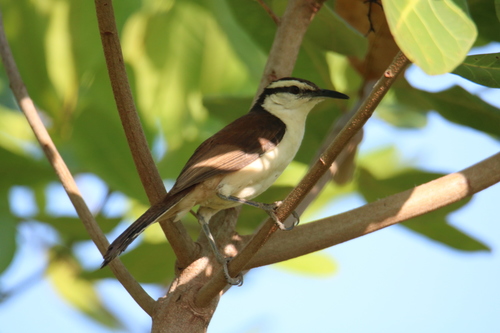
The bicolored wren, with the scientific name Campylorhynchus griseus (Swainson, 1838), is the largest wren species in South America, and is the second largest species in the wren family overall, with only the giant wren larger than it. Adults of this species are 21 to 22 cm (8.3 to 8.7 in) long and weigh 37 to 46.5 g (1.31 to 1.64 oz). Males and females have similar plumage. Nominate adult bicolored wrens have dark chocolate-colored crowns and napes, and their upperparts are a paler shade of chocolate. An off-white supercilium separates a dark brown stripe that runs through the eye from the crown, and the rest of the face is also white. Their tail is dark brown; all tail feathers except the middle pair have a white band near the tip. The throat and the entire underparts of the bird are white. Multiple recognized subspecies differ in appearance from the nominate: C. g. albicilius is rustier than the nominate, as is C. g. bicolor, but C. g. bicolor has a lighter rump. C. g. minor is smaller, with blackish brown nape and upper back. C. g. pallidus is paler and grayer than the nominate, and has a darker crown. Juvenile bicolored wrens are grayer than adult birds, with mottled gray-brown caps and grayish white underparts. The subspecies of the bicolored wren have distinct distribution ranges: C. g. albicilius is found in northern Colombia and northwestern Venezuela, with a few records from far eastern Panama; C. g. bicolor is found in the upper Magdalena Valley of western Colombia and the west slope of the Eastern Andes; C. g. griseus ranges from eastern Venezuela through western and southwestern Guyana into extreme northern Brazil; C. g. minor is found in northern Venezuela and eastern Colombia; C. g. pallidus occurs in Amazonas State of southern Venezuela; C. g. zimmeri is found in Huila and Tolima Departments of central Colombia. The bicolored wren lives in areas with scattered trees and bushes, and is completely absent from forests and wide open areas. The subspecies C. g. bicolor occurs in arid thorn scrub, while all other subspecies live in significantly more humid areas. In terms of elevation, this species ranges up to 2,100 m (6,900 ft) in Colombia, and up to 1,600 m (5,200 ft) in Venezuela.