About Campylorhynchus fasciatus (Swainson, 1838)
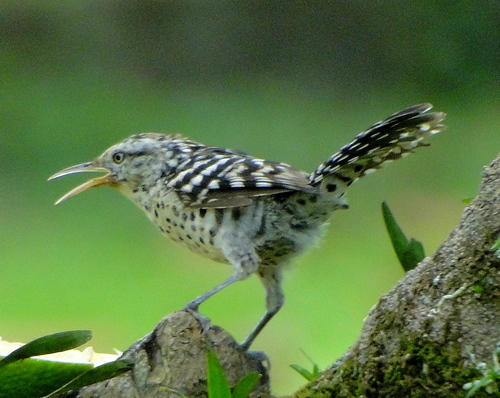
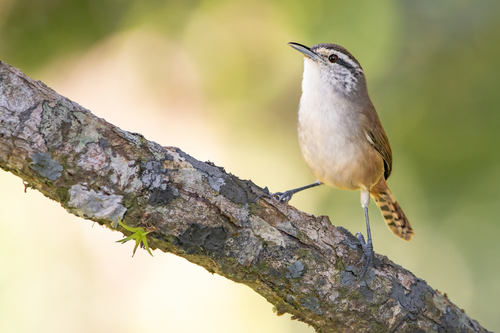
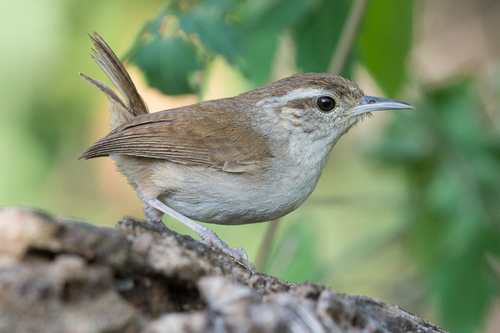
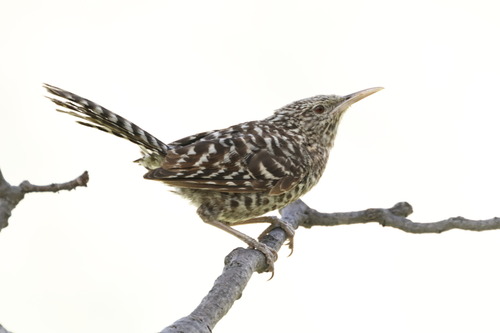
The fasciated wren (Campylorhynchus fasciatus) is approximately 19 cm (7.5 in) long, and one recorded female individual weighed 24.9 g (0.88 oz). For the nominate subspecies, both sexes share the same plumage pattern: a gray crown, grayish supercilium, and dark gray shoulders, back, and rump. The shoulders have whitish speckles, while the rump has whitish bars. The tail is patterned with alternating off-white and blackish brown bars. The chin is off-white with darker streaks. The whitish chest and belly are marked with heavy dark gray spots, and the flanks have dark gray bars. The subspecies C. f. pallescens is paler overall, with less distinct markings on its underside. Juvenile fasciated wrens also have less well-defined markings on their undersides. The nominate subspecies is distributed in coastal Peru from the Department of Piura south to the Department of Lima, and also in inland Peru from the departments of Cajamarca and Amazonas south to the Department of Huánuco. C. f. pallescens is found from southwestern and southern Ecuador into Peru's departments of Tumbes and Piura. The fasciated wren primarily inhabits arid and semi-arid landscapes such as thorny scrublands. It also occurs in citrus orchards and other areas heavily modified by human activity. In Ecuador, the species occupies more humid habitats including deciduous forest. Most individuals are found between sea level and 1,500 m (4,920 ft) in elevation, but the species can occur as high as 2,500 m (8,200 ft).