About Campylopterus largipennis (Boddaert, 1783)
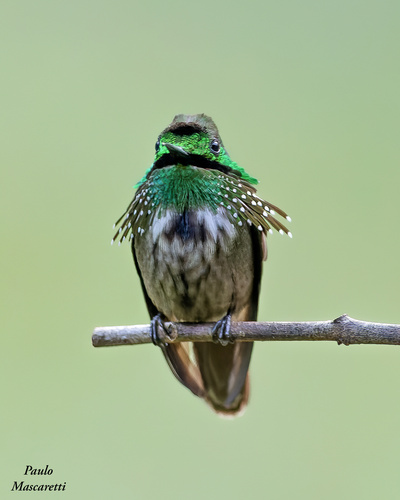
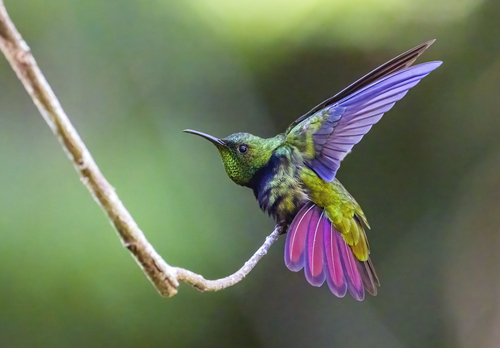
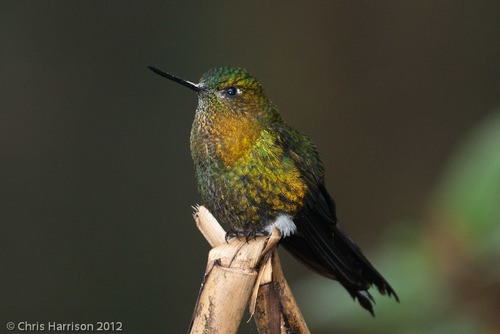
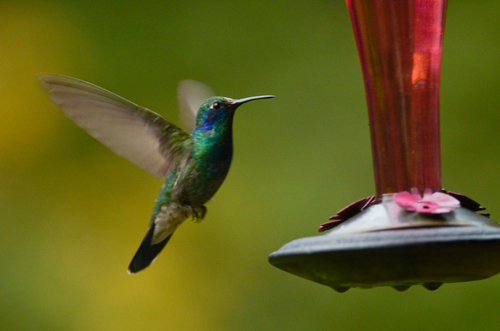
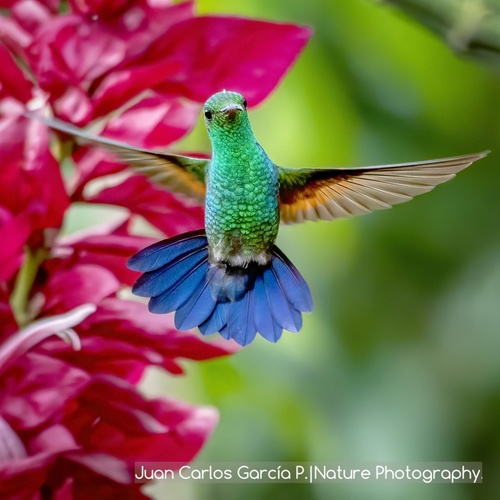
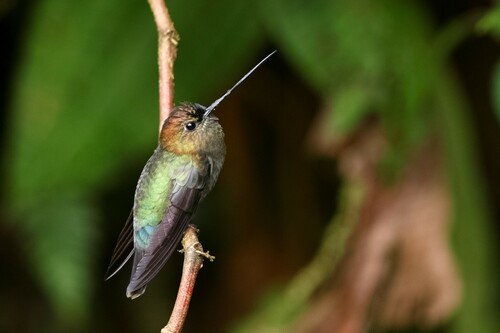
The grey-breasted sabrewing (scientific name Campylopterus largipennis, first described by Boddaert in 1783) is a large species of hummingbird. Adults measure 12.4 to 14.9 cm (4.9 to 5.9 in) in total length. Males weigh between 9 and 10 g (0.32 to 0.35 oz), while females are smaller, weighing approximately 7 to 8 g (0.25 to 0.28 oz). The sexes have nearly identical plumage. The bill is slightly curved downward; the upper mandible (maxilla) is black, and the lower mandible (mandible) is pinkish with a black tip. For the nominate subspecies C. l. largipennis, the upperparts are dark shining green, and the underparts are dark gray. All individuals have a small white spot behind the eye. The central pair of tail feathers is green; the remaining tail feathers are bluish black on their inner half and white on their outer half. Subspecies C. l. obscurus, which is grouped with C. l. aequatorialis, is smaller than the nominate subspecies, and the tips of its outer tail feathers are usually gray rather than white. The International Ornithological Congress (IOC) recognizes three subspecies of grey-breasted sabrewing, with the following distributions: C. l. largipennis is found in eastern Venezuela, the Guianas, and northern Brazil extending west to the Rio Negro; C. l. obscurus is found in northeastern Brazil; C. l. aequatorialis ranges from eastern Colombia and northwestern Brazil, south through eastern Ecuador and Peru into northern Bolivia. The species inhabits humid primary forest, humid secondary forest, forest clearings, and plantations. It occurs at elevations between 100 and 800 m (330 and 2,600 ft).