About Campylopterus hemileucurus (Deppe, 1830)
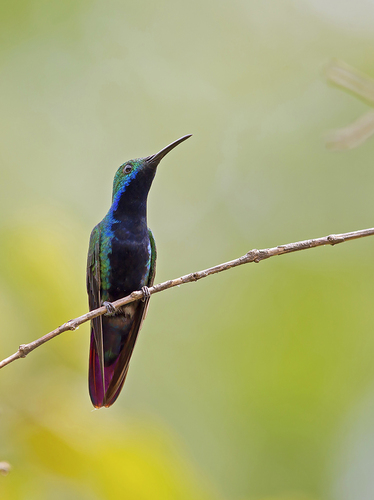
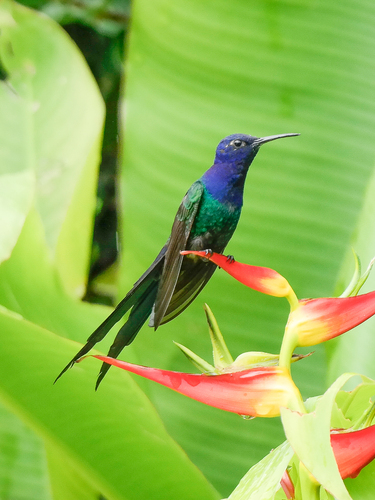
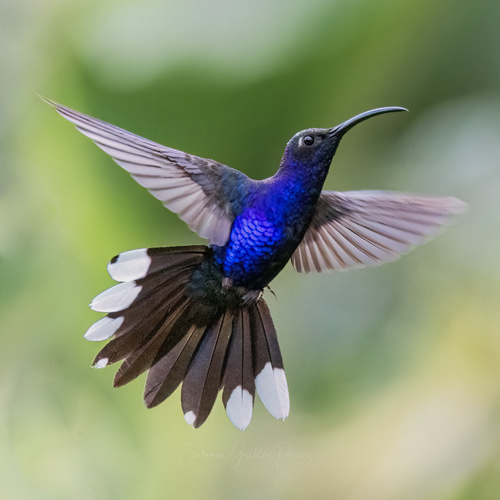
Campylopterus hemileucurus, commonly known as the violet sabrewing, is the largest hummingbird found in Mexico and Central America. It measures 13 to 15 cm (5.1 to 5.9 in) in length and weighs 9 to 12 g (0.32 to 0.42 oz). Both sexes of the species have a black bill; the bills of the C. h. mellitus subspecies are longer than those of the nominate subspecies. Males of the nominate subspecies have a dusky crown with a bluish green gloss. Their nape, upper back, face, and underparts are metallic violet blue, with a slightly bluer tone on the belly. Their lower back and uppertail coverts are metallic green. Their central tail feathers are bluish green to bluish black, while the rest of the tail feathers are blackish with wide white tips. Females of the nominate subspecies have a dusky crown and metallic green to bronze green upperparts, with a more bluish green rump. They have a violet blue throat. Most of their underparts are gray, with a whiter belly, metallic green spots along the sides, and green undertail coverts. Their central tail feathers are bluish green, and the rest are blacker with wide white tips. Males of the C. h. mellitus subspecies have more green on their upperparts than the nominate subspecies, and have almost entirely violet underparts with no blue on the belly. Females of this subspecies have a coppery tinge to their upperparts and a violet throat. The nominate subspecies of violet sabrewing is distributed intermittently from the Mexican states of Guerrero and Veracruz south through Guatemala, southern Belize, Honduras, and El Salvador into northern Nicaragua. The C. h. mellitus subspecies occurs along most of the length of Costa Rica extending into western Panama. This species inhabits the edges and interior of humid evergreen montane forest, mature secondary forest, banana plantations, and gardens. In Mexico, it generally occurs at elevations between 500 and 2,000 m (1,600 and 6,600 ft), and can be found as high as 2,500 m (8,200 ft). In Costa Rica, it ranges between 1,500 and 2,400 m (4,900 and 7,900 ft) in elevation.