About Campylopterus falcatus (Swainson, 1821)
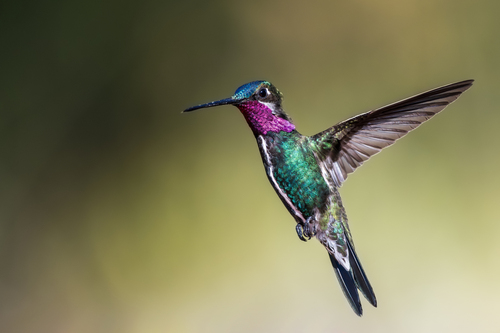
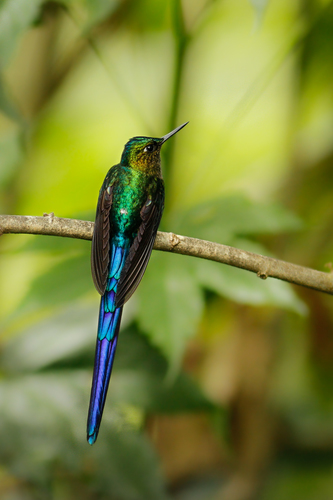
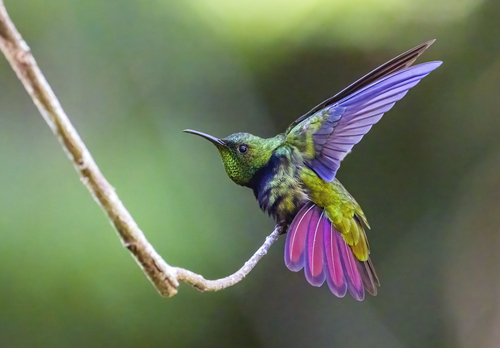
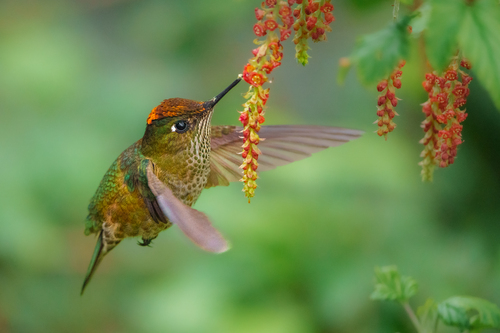
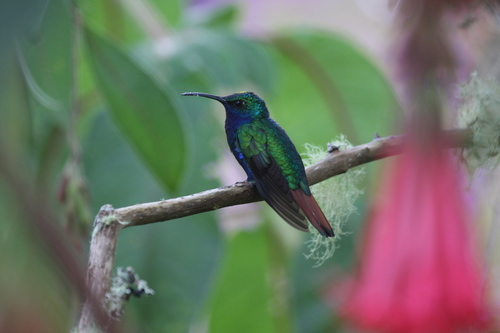
The lazuline sabrewing (Campylopterus falcatus (Swainson, 1821)) measures about 11.5 to 13 cm (4.5 to 5.1 in) long and weighs 6.4 to 8 g (0.23 to 0.28 oz). Both sexes have a black decurved bill and a white spot behind the eye. Males have glittering green upperparts, which are bluer on the crown. Their throat and breast are glittering dark violet-blue, fading to glittering blue toward the green belly. Their tail is chestnut, with wide bronze-green tips on the central pair of feathers. Female upperparts match the male's. Females have a glittering bluish throat, and the rest of their underparts are pale gray with green spots on the flanks. Their tail is the same as the male's, except the central feather tips have less green. The lazuline sabrewing is distributed across the mountains of north-central and western Venezuela, the Sierra de Perijá along the Venezuela-Colombia border, the Sierra Nevada de Santa Marta and Eastern Andes of Colombia, and extends south into Ecuador to Napo Province. It inhabits semi-deciduous montane forest, plantation edges, the lower reaches of páramo, and gardens. Its general elevation range is between 900 and 3,000 m (3,000 and 9,800 ft). In Venezuela, it is most common between 1,200 and 2,300 m (3,900 and 7,500 ft), and has been recorded as low as 450 m (1,500 ft) in Colombia.