About Campyloneurum phyllitidis (L.) C.Presl
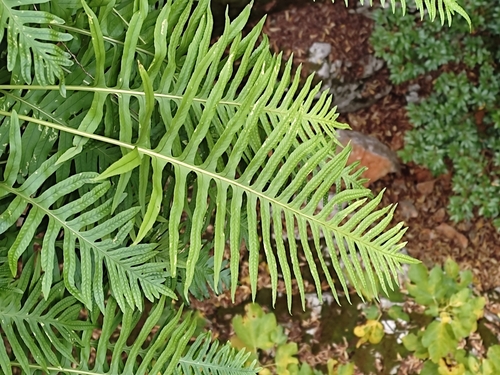
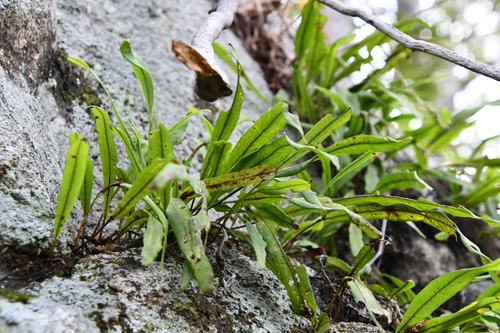
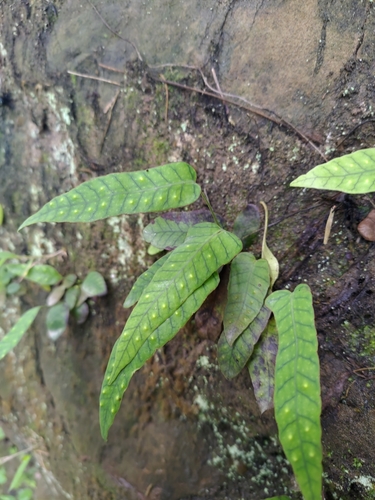
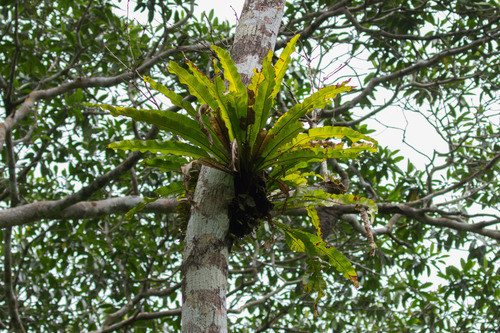
Campyloneurum phyllitidis (L.) C.Presl is an epiphytic fern that grows on other plants, most commonly in tree canopies. It has a relatively large rhizome that produces many fine rootlets covered in dark reddish-brown scales. Its leaves are simple in shape, hairless, and measure 45–100 centimetres (18–39 in) long by 8–12 centimetres (3.1–4.7 in) wide. It produces small, round sori that grow on both sides of the leaf lateral veins. This fern has been recorded growing as an epiphyte on the specific species Platypodium elegans, Ceiba pentandra, Tabebuia guayacan, Anacardium excelsum, Socratea exorrhiza, Marila laxiflora, and Perebea xanthochyma. This species is distributed across North, Central, and South America. Its range extends from Florida, the Caribbean, and southeastern Mexico in the north, to tropical Peru, Brazil, and Paraguay in the south. It is native to the southeastern United States, Cuba, Costa Rica, Bolivia, and Venezuela, and is also present in Florida, Puerto Rico, Hawaii, and the Virgin Islands. It is a common fern on Panama's Barro Colorado Island. Campyloneurum phyllitidis is cultivated as an ornamental plant, and it is the most common species of the genus Campyloneurum grown in cultivation. It grows well in well-drained soil under medium light levels, and requires protection from slugs and snails. It was grown in England during the Victorian era, a period when ferns were extremely popular in a cultural phenomenon called pteridomania. Victorian fern author Shirley Hibberd described this species as "very distinct", and noted that it forms a "striking object when grown well".