About Campyloneura virgula (Herrich-Schaeffer, 1835)
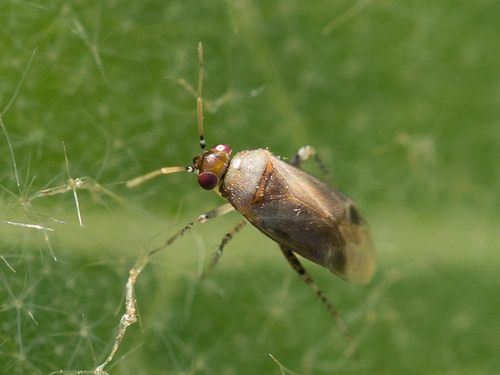
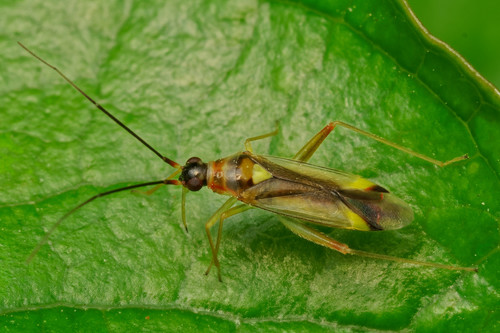
Campyloneura virgula (Herrich-Schaeffer, 1835) can reach a body length of 4–5 millimetres (0.16–0.20 in). Adult individuals have pale translucent hemelytra, a red stripe along the edge of a pale green pronotum, a yellow scutellum, a black head, long antennae with red bands, and bright yellow cunei tipped with dark red. Their legs are pale yellow. Nymphs are yellow, and also have a red stripe along the edge of the pronotum. This species is widespread across the Nearctic realm, Europe, and the Mediterranean region, extending as far east as Turkestan. It has also been introduced to the United States of America. Campyloneura virgula is a common predatory bug that hunts small insects such as aphids and red mites. Adults can be found flying from June to October, and during this period they live on many types of deciduous trees, including hazel, hawthorn, and oak. Adults overwinter, and nymphs emerge in May. A distinctive trait of this bug is that males are extremely rare across almost its entire range, because C. virgula reproduces through parthenogenesis, or reproduction without mating. The only exceptions to this characteristic are Sicily and North Africa, where males are commonly found and the species reproduces normally through sexual reproduction.