About Camptostoma imberbe P.L.Sclater, 1857
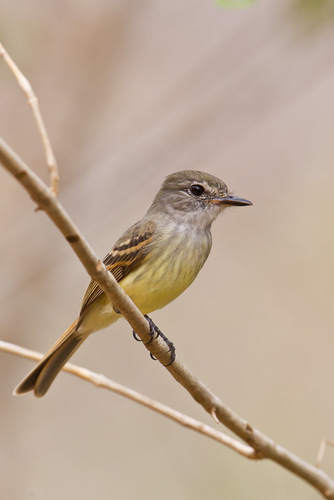
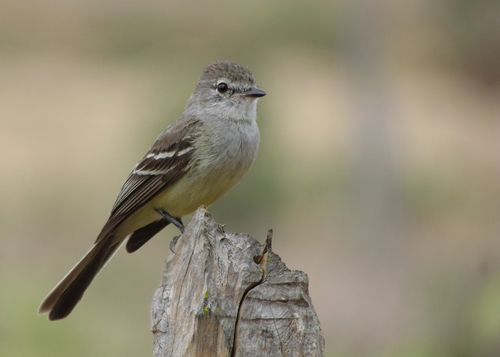
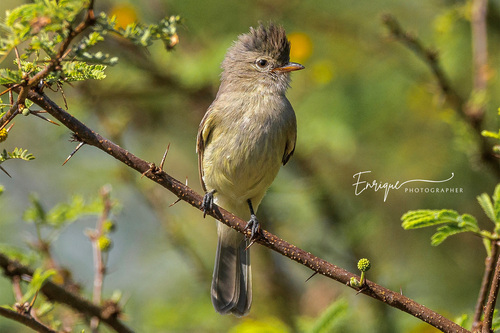
The northern beardless tyrannulet, scientifically named Camptostoma imberbe P.L.Sclater, 1857, is a small passerine bird that belongs to the tyrant flycatcher family. It breeds across a range extending from the extreme southeastern portions of Arizona and Texas in the United States, through Mexico and Central America, to northwestern Costa Rica. This species inhabits light forests, cultivated land, and tree-containing gardens. It builds a domed nest from plant fibre or leaves, which has a side entrance and is positioned at a tree fork. The typical clutch for this species contains two white eggs, marked with rufous and lilac markings that are mostly concentrated at the larger end of the egg. The female alone incubates the eggs for 14–15 days until hatching, and the young take a further 17 days to fledge. Adult northern beardless tyrannulets measure 10.2 cm (4.0 in) in length and weigh 7.5 g (0.26 oz). They have a dark brown head with an erectile crest and a pale supercilium. Their upperparts are grey-green, growing paler on the rump. The wings are brown with yellow feather edging and two whitish wing bars. The tail is brown, the throat is grey, the breast is yellowish, the abdomen is yellow, and the bill is pinkish. Males and females of this species have similar appearance. This species always looks less bright than its close relative the southern beardless tyrannulet, C. obsoletum, particularly in the colour of its wing bars. The two species were once considered to be the same species, but their ranges overlap in Costa Rica without any interbreeding between them. Northern beardless tyrannulets are active birds. They feed in a vireo or warbler-like style, eating insects, spiders, and berries. Their call is a loud whistled Fleeeeeerrr, which is sometimes broken into a fleeer-it or a sequence of flee-flee-flee-flee. During courtship or when alarmed, these birds raise their crests, flick their tail, and give an excited call.