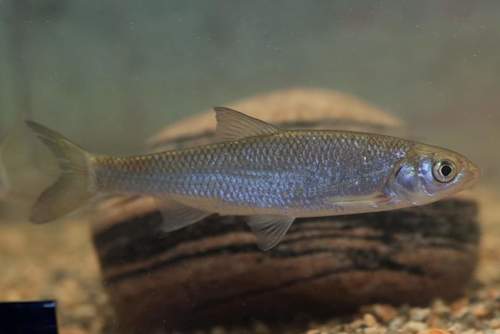
About Campostoma oligolepis Hubbs & Greene, 1935
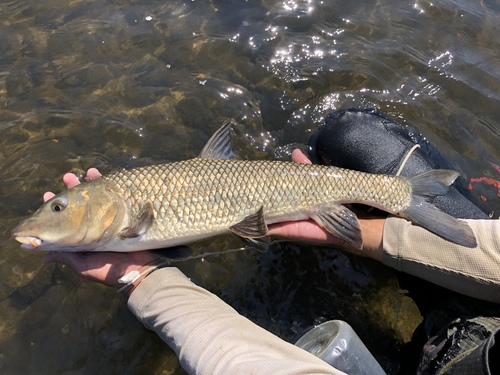
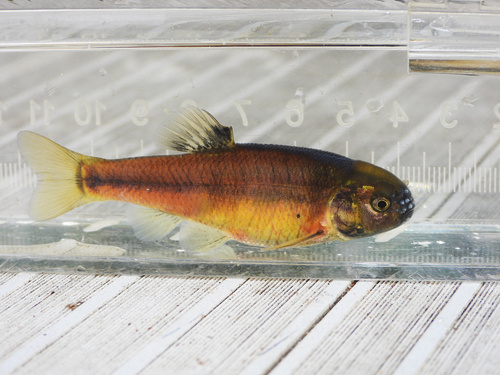
The largescale stoneroller (Campostoma oligolepis Hubbs & Greene, 1935) is a species of freshwater ray-finned fish belonging to Leuciscidae, the family of shiners, daces, and minnows. This fish occurs in the eastern United States. Its native range covers many North American streams, rivers, lakes, and creeks. Native populations are found in the Upper Mississippi River and Lake Michigan drainages of Wisconsin, eastern Minnesota, eastern Iowa, and northern Illinois; Ozarkian streams of central and southern Missouri, and northern Arkansas; the Mobile Bay drainage of Georgia, Alabama, and eastern Mississippi; and parts of the Green, Cumberland, and Tennessee River drainages of Kentucky, Tennessee, Georgia, and Alabama. It has also been introduced to other areas of North America, including the Illinois River in Oklahoma. Introduction to Oklahoma is thought to be linked to its popularity as a baitfish, and any effects of this introduction on the area have not been observed by scientists and researchers. The overall distribution of the largescale stoneroller extends from Alabama to Oklahoma. The largescale stoneroller lives in well-oxygenated waters with temperatures around 0–8 °C (32–46 °F), low turbulence, and reduced water flow. It prefers upland habitats located above the Fall Line. It is a herbivorous fish that feeds on diatoms, green algae, and blue-green bacteria, and tends to ingest less sand and silt than the central stoneroller. Its predators include largemouth bass, smallmouth bass, spotted bass, sauger, and walleye. Because it is a popular baitfish, anglers also catch it for fishing. The largescale stoneroller can tolerate polluted water, so it does not have many competing species. Largescale stoneroller generally reach sexual maturity between one and four years of age. For breeding, males first construct nests in gravel bars and rocks in late winter. Females arrive in spring to lay eggs, which males then fertilize. A single female can lay between 400 and 4,000 eggs at a time. After breeding, both males and females leave the nest unattended, and newly hatched fry must hatch and survive on their own. The fry stay together in schools to feed and protect one another. The largescale stoneroller has a typical life expectancy of around five years.