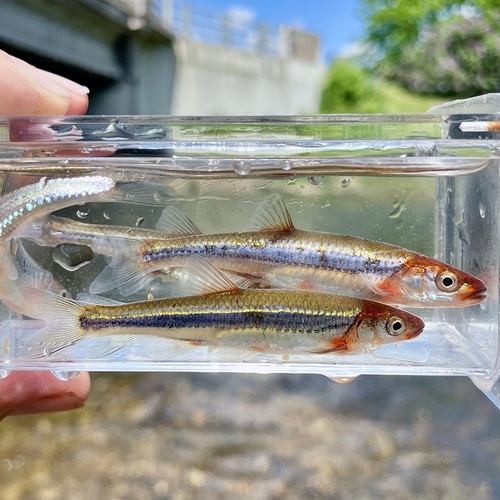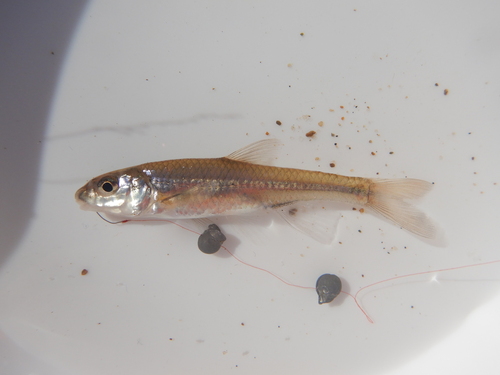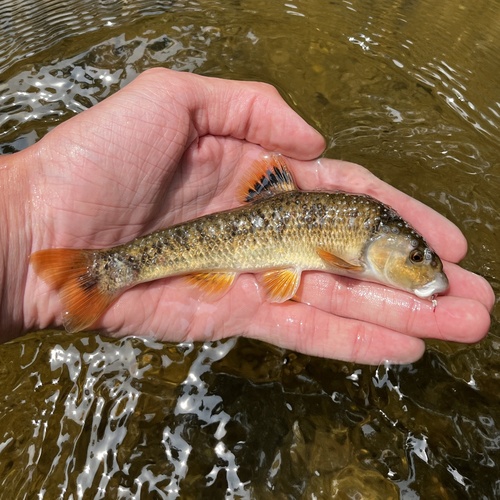
About Campostoma anomalum (Rafinesque, 1820)
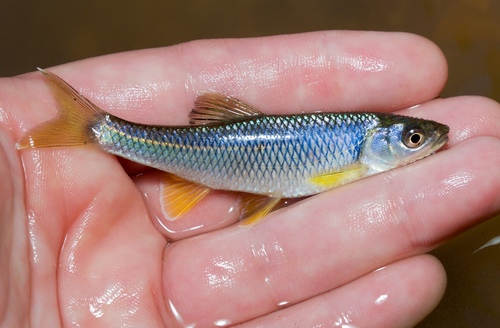
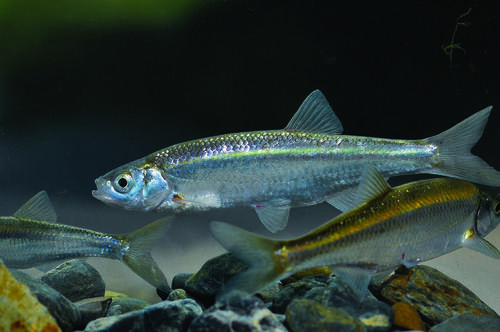
The central stoneroller, also called the Ohio stoneroller, with the scientific name Campostoma anomalum (Rafinesque, 1820), is a species of freshwater ray-finned fish that belongs to Leuciscidae, the family of shiners, daces and minnows. It is found across North America. This species is widespread in freshwater streams across a large part of the eastern, central, and midwestern United States. It occurs in the Atlantic Ocean, Great Lakes, Mississippi River, and Hudson Bay basins within the US, ranging from New York west to North Dakota and Wyoming, and south to South Carolina and Texas. Isolated populations also exist in Canada and Mexico. The central stoneroller is benthopelagic, meaning it lives in either the midwaters or the bottom of freshwater streams and rivers. It needs some amount of current, and is most commonly found in riffles and pools of moderate to high gradient streams that have a gravel substrate bottom. It is a very tolerant species, however, and can live in almost any stream system that has enough food, which has allowed it to become widely distributed. In terms of feeding ecology, the central stoneroller is generally herbivorous. It feeds primarily on algae that it scrapes off of rocks and logs using a cartilaginous ridge on its lower jaw. Young central stonerollers feed on rotifers, filamentous algae, and microcrustaceans. This species also eats detritus and diatoms, and will occasionally consume aquatic insects. It is categorized as a grazing minnow based on its feeding behavior, and large schools of these fish often feed together. Central stonerollers may eat up to 27 percent of their total body weight in benthic algae each day. A study conducted in Kansas found that algae made up the largest portion (47 percent) of the central stoneroller diet, followed by detritus at 30 percent, animal matter at 21 percent, and terrestrial vegetation at 2 percent. Human-induced factors that lower the abundance of the central stoneroller include altered flow regimens, habitat fragmentation, impacts to aquatic and riparian habitat linked to agricultural practices, and increased siltation and aquatic vegetation.