About Camponotus nigriceps (Smith, 1858)
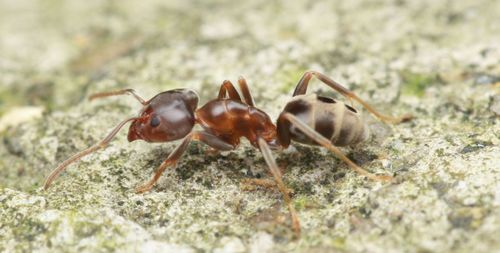
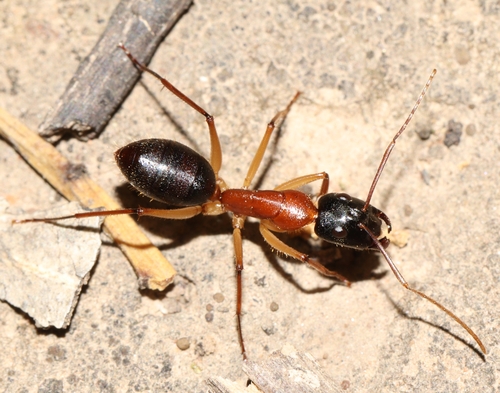
Camponotus nigriceps (Smith, 1858), commonly called the black-headed sugar ant, is a relatively large, polymorphic ant species with two worker castes: minor workers and major workers, also known as soldiers. For the main species, workers and soldiers measure between 10 and 12 millimetres (0.39 to 0.47 in); males measure 12 millimetres (0.47 in), while queens are the largest at 16 millimetres (0.63 in). Workers of the subspecies Camponotus nigriceps lividipes only reach 6 to 10 millimetres (0.24 to 0.39 in) in length. The colour of workers' gasters and mesosomas varies: the gaster may be black, brown, or yellowish-brown, and the mesosoma may be reddish-brown or yellow. Most workers are primarily brown, with noticeable light patches on the head and mesosoma, darker clypei and mandibles, and legs that are either black or brown. A large number of hairs grow from the gaster, mesonotum, pronotum, and propodeum, with an average individual hair length of 0.35 millimetres (0.01 in). Golden, erect setae are present under the head and on the mesosoma, and the setae on the tibia are shorter than those on the mesosoma. Workers have bulging eyes, while soldiers have flat eyes. Within the Camponotus nigriceps species group, the black-headed sugar ant is easily confused with the banded sugar ant due to their similar appearance. However, banded sugar ants are darker and have a distinct band wrapping around their gaster, a feature that is not present on black-headed sugar ants. Minor worker specimens are typically examined to identify these similar-looking species. The black-headed sugar ant occurs across most Australian states. It is restricted to northern and south-eastern Queensland, and is widespread throughout the Australian Capital Territory. It is also widespread across New South Wales and Victoria, though it is absent from north-western New South Wales and south-eastern Victoria. In South Australia, it is common in south-eastern regions and less frequently encountered in the north-west. Populations exist in Western Australia, but are not found in the northern regions of the state, nor anywhere in the Northern Territory. Black-headed sugar ants mostly live in dry regions, including dry sclerophyll woodland, open areas, and pastures. Other preferred habitats include mallee, eucalyptus woodland, and Casuarina cristata woodland, at elevations ranging from 241 to 319 metres (791–1,047 ft). Nests are built in laterite soil in upland areas, surrounded by tall eucalyptus trees or under groves. They may also be built in large mounds or under stones. Black-headed sugar ants sometimes inhabit cedar wood and large mounds that are already occupied by meat ants (Iridomyrmex purpureus). Black-headed sugar ants are nocturnal foragers. They are sometimes considered a household pest, because they enter human homes at night while searching for food. They are inactive during the day, displaying sleep-like behaviours until nightfall. Their diet consists predominantly of sweet secretions and sugar water, but they also consume insects and a variety of household foodstuffs. When moving colonies to new nest sites or leading nestmates to food sources, workers use several social methods: worker carrying, tandem running, or laying pheromone trails for orientation. They also act as attendants for the butterflies Ogyris idmo and Ogyris genoveva. The butterfly larvae live in underground structures built by the attending ants, and emerge with the ants at night to feed on mistletoe leaves. This species tolerates myrmecophiles: the beetles Ctenisophus morosus and Cryptodus paradoxus, the wingless cricket Myrmecophilus australis, and froghoppers from the family Cercopidae have all been recorded living inside black-headed sugar ant nests. Multiple predatory animals prey on the black-headed sugar ant. Workers' body parts have been found in the stomach contents of several bird species, confirming they prey on this ant: the black-faced woodswallow, rufous treecreeper, noisy miner, jacky winter, and southern scrub robin. The rainbow trout is also recorded as a predator of this species. Nuptial flight most likely begins in summer, as a young mated queen without brood was found in a newly built chamber in January. Early in colony foundation, colonies have more soldiers, while older colonies may have a workforce made up entirely of minor workers. A typical colony holds 5,000 to 7,000 individual ants. Camponotus nigriceps queens have an exceptionally long lifespan: wild queens can live up to 21 years, and one recorded captive queen lived to 23 years of age, making it the second oldest recorded ant queen. Larvae of this species can grow quite large; collected specimens have reached 16.4 millimetres (0.65 in) in length.