About Camponotus floridanus (Buckley, 1866)
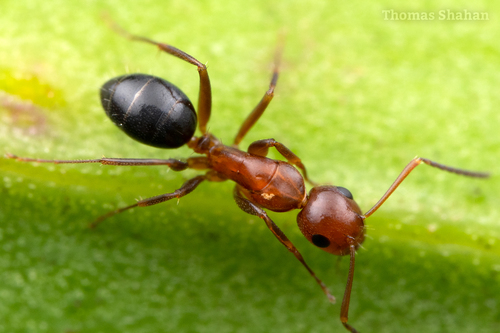
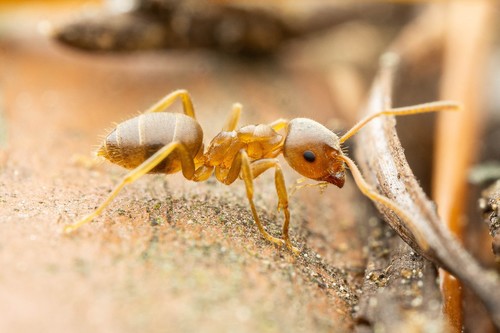
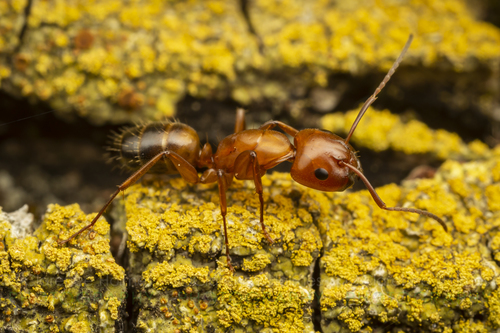
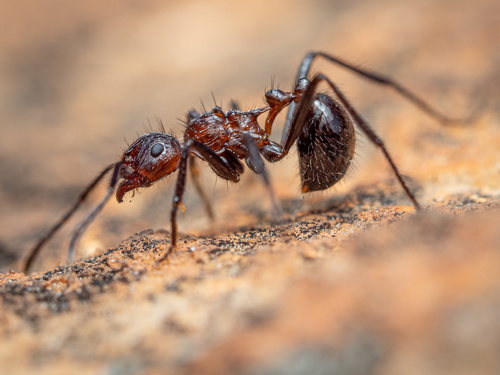
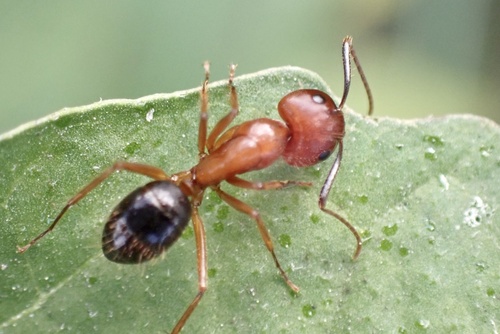
Camponotus floridanus, the Florida carpenter ant, is one of the most familiar ant species in Florida, known for its large size and noticeable coloration. Workers and queens are bicolored, with a reddish-orange head, bright to dull orange mesosoma and legs, that stand in sharp contrast to a deep black gaster. Male alates of this species are more uniformly colored, primarily ranging from rusty orange to cider orange. This species can be told apart from the visually similar, smaller Camponotus tortuganus by having a head wider than it is long, smaller but stockier legs relative to the body, and an overall stouter body shape. Queens average 14 to 16 mm in length. Workers are highly polymorphic, and the largest major workers can reach similar lengths to queens, measuring 11 to 13 mm. Minor and media workers are typically around 4 to 9 mm long. The native range of Florida carpenter ants is most heavily concentrated across Florida. It also spreads mainly along coastal areas north into Georgia and southern South Carolina, with rare recorded sightings as far north as Clayton, North Carolina. Its range also extends west along the Florida panhandle, through Baldwin and Mobile Counties in southern Alabama, and into the far southeastern corner of Mississippi. There have also been many reported sightings of the species around Houston, Texas. Nuptial flights for reproduction begin around May and reach their peak in the summer months. Flights are triggered after heavy rains that raise air humidity to between 80 and 90%, and when temperatures stay around 80°F or higher half an hour after sunset. Female alates mate once in the air, then move to the ground to search for a site to start a new colony. The Florida carpenter ant is highly productive, and colonies grow quickly, reaching 1,000 workers within the first year. Mature colonies can potentially exceed 8,000 individuals after 2 to 3 years. Both male and female alates are attracted to bright white lights, and can be found in large groups around street lights, court lights, and field lights. Queens are fully claustral, and colonies are monogynous, meaning each colony contains only one queen.