About Campethera nubica (Boddaert, 1783)
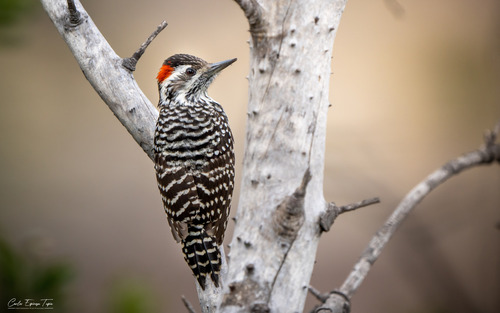
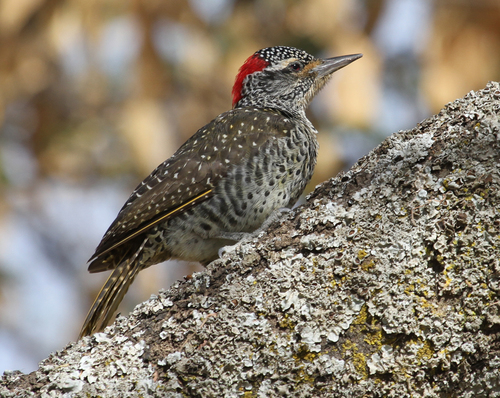
The Nubian woodpecker, scientifically named Campethera nubica (Boddaert, 1783), is a medium-sized species that reaches an approximate length of 21 cm (8.3 in). Males have a red crown and nape, plus a reddish streak on the cheek. Females differ in head markings: they have a black crown speckled with white, a red nape, and a dark cheek stripe with white speckling. All other physical traits are the same between the two sexes. The upperparts are olive-brown, marked with extensive cream speckling and barring. The wings are greenish-brown with white barring, and the tail is greenish-yellow with brown barring, with gold-colored feather shafts. The throat is cream-colored, while the head, neck, breast, and belly are white with black spotting and barring. The beak is grey with a dark tip; the eye is red or pink; the orbital ring is grey; and the feet are olive or grey. This species produces a range of vocalisations: repeated shrill ringing or piping notes that are often musical, and sometimes metallic. Songs are frequently performed as duets. The Nubian woodpecker is endemic to eastern Africa, with a range covering Chad, the Democratic Republic of the Congo, Djibouti, Eritrea, Ethiopia, Kenya, Somalia, South Sudan, Sudan, Tanzania, and Uganda. Its typical habitat is open savannah woodland, particularly areas with Acacia and Euphorbia, as well as bushy areas and scrub. It is a non-migratory species, found at altitudes up to 2,000 m (6,600 ft). The Nubian woodpecker most often feeds alone, and stays in contact with its mate through vocal communication. It forages mainly in trees, but also feeds on the ground, targeting ants and termites. It also consumes spiders and beetles.