About Campethera notata (M.H.K.Lichtenstein, 1823)
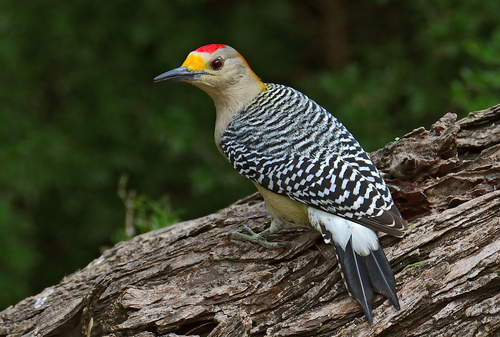
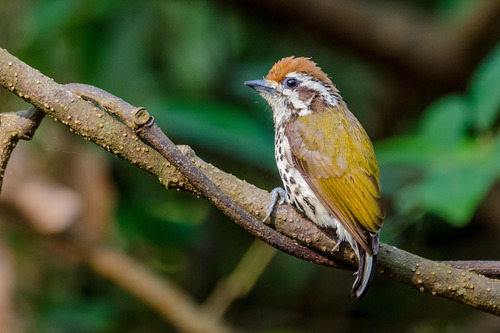
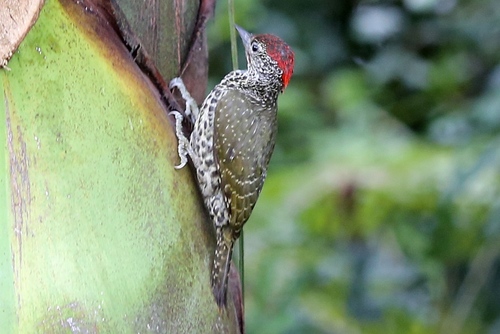
Campethera notata, commonly known as the Knysna woodpecker, can be distinguished from other South African woodpecker species by its thickly spotted underside, which is covered in black spots extending from the chin to the vent. Males and females differ slightly in appearance. Males are olive-green on their upperparts, marked with faint small transverse bars and a small number of diamond-shaped paler olive-yellow sub-terminal spots. Females match males in most features, except their black head is spotted with white, and only the occiput is scarlet. The primary flight quills are brown, turning olive externally near their base. Secondary quills are olive-brown, duller than the back, and crossed by transverse bars of yellow-tinged white. Primaries have yellow spots on their outer edges, white notches on their inner webs, and brown shafts. The tail is olive-brown with an almost green tint, crossed by six nearly yellow bars. Tail feather tips are dull golden, and their shafts are golden brown. For males, the head is gray-black, and all head feathers are tipped with scarlet. The occipital crest, located at the base of the cranium, is entirely bright scarlet. The lores are yellowish and finely spotted with black. Ear-coverts are whitish with black streaks, and the front portion of the cheeks is scarlet. The rest of the sides of the face and neck are yellowish white, thickly mottled with black; feathers in this area are black with narrow whitish edges. The body underside is yellowish, with white on the throat, and is thickly spotted as noted earlier. The spots are rounded and very large on the breast, becoming more diamond-shaped on the abdomen. The flanks are barred with dusky black, and the underwing coverts are yellow with round black spots matching those on the breast. Eyes are hazel in color. The species has an approximate total length of 8.5 inches (22 cm). This woodpecker is endemic to South Africa. It is thinly spread across South Africa's coastal lowlands, ranging north into southern KwaZulu-Natal and west to near Bredasdorp in the Western Cape. It is common in localized areas, but not across its entire coastal range. Its total distribution covers less than 50,000 km² (19,000 sq mi). The total population is estimated at 1,500 to 5,000 individuals, of which 1,000 to 3,300 are assumed to be mature breeding birds. Breeding occurs between August and November, with most breeding activity taking place in October. Breeding pairs are widely spaced. Pairs excavate a nest hole in a dead tree trunk or branch. Clutch size ranges from 2 to 4 eggs. Incubation lasts 13 to 21 days, after which the fledgling period lasts 4 to 6 days.