About Campephilus rubricollis (Boddaert, 1783)
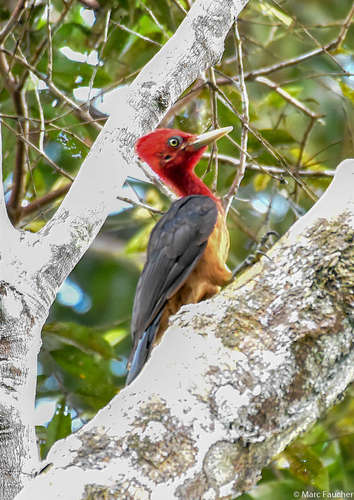
The red-necked woodpecker (Campephilus rubricollis) is around 30 to 35 cm (12 to 14 inches) long, and weighs 178 to 236 g (6.3 to 8.3 oz). For the nominate subspecies C. r. rubricollis, both sexes have black to brownish black upperparts. The upper surface of their wings is black, with rufous coloring on the inner vanes of the flight feathers. The underside of their wings is rufous, with a blackish trailing edge and blackish feather tips. Their tail is black on the upper side and brownish black on the lower side. Their underparts have bright red coloring on the breast, which shifts to rufous to rufous cinnamon toward the vent. Adult males have fully red heads and necks, with a small black and white spot on the ear coverts. Adult females lack this spot on the ear coverts, and instead have a wide whitish stripe with black edges that runs from the bill to the ear coverts. Their bill is a long, chisel-shaped structure that is pale grayish white to ivory in color. Their iris is yellowish white, and their legs are blackish gray or olive. Juveniles look similar to adults, but are duller and browner overall, and their red-colored areas are more orange than red. Subspecies C. r. trachelopyrus is larger and darker than the nominate subspecies. Its underparts are more chestnut than red, and the upper side of its wing has more rufous coloring than the nominate. Subspecies C. r. olallae is intermediate in size between the other two subspecies. Its coloration is also intermediate: its red and rufous coloring is brighter than that of trachelopyrus, but less bright than that of the nominate. The three subspecies have separate ranges: C. r. rubricollis is found in eastern Colombia and eastern Ecuador, extending through southern Venezuela, the Guianas, and into northern Brazil north of the Amazon. C. r. trachelopyrus is found in northeastern Peru, west-central Bolivia, and western Brazil south of the Amazon. C. r. olallae is found in Brazil south of the Amazon, between the Madeira River and the Atlantic coast in Maranhão, extending south to Mato Grosso and central Bolivia. The red-necked woodpecker is native to the Amazon Basin, where it lives in rainforest, terra firme forest, and várzea forest. It generally prefers the interior of forests, but also occurs at forest edges, in secondary forest, and in woodland growing along watercourses in savannah areas. Most of its range lies between sea level and 600 m (2,000 ft) in elevation, though it can reach 1,800 m (5,900 ft) locally in southern Venezuela and northwestern Brazil, and up to 2,400 m (7,900 ft) in Bolivia.