About Campephilus pollens (Bonaparte, 1845)
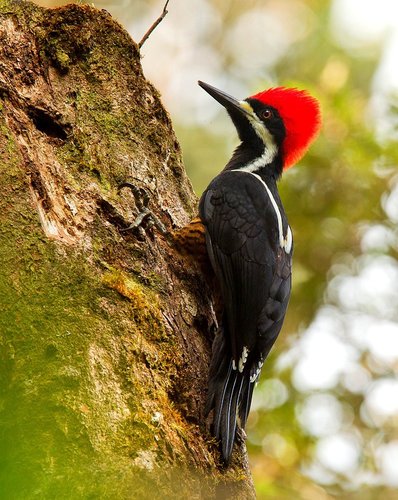
Powerful woodpeckers (Campephilus pollens) reach about 32 cm (13 inches) in total length. The only difference between adult sexes appears on the head: adult males have red plumage from the forehead to the crest, while this area is black on females. For the nominate subspecies, both sexes have a black and white patterned face including the throat; white forms a wide stripe running from the lores to below the back of the ear coverts, and continues down the side of the neck. Both sexes have black plumage on the hindneck, mantle, scapulars, and upper back, with narrow white stripes along each side of this region. The lower back and rump are white, and the uppertail coverts are black. The upper surface of the wings is black, with white tips on the primary feathers and some white spots or bars on the secondary feathers. The underside of the wings is blackish with white bars. The tail is entirely black. The center of the breast is black, and the rest of the underparts are cinnamon-buff with black bars or chevron-shaped markings. The bill is a long, black, chisel-shaped structure; the iris is white or pinkish white, and the legs are dark gray. Juvenile birds resemble adults, but their plumage is duller and browner, with more bars on the upperparts and wider bars on the underparts. The subspecies P. p. peruvianus differs from the nominate subspecies by having cinnamon-buff lower back and rump, which often also have black bars, and frequently has cinnamon-buff bars on its black uppertail coverts. The nominate subspecies of powerful woodpecker is found in the Andes from north-central Colombia and southwestern Venezuela, extending south through Ecuador almost to Peru. Subspecies P. p. peruvianus occurs on the east slope of the Peruvian Andes, as far south as the Department of Junín. This species mostly lives in the interior and edges of mature montane forest, humid and wet forest, and cloudforest. It can also be found in secondary forest and other more open types of forest. Its elevation range spans from 900 to 3,750 m (3,000 to 12,300 ft), but most individuals are found between 1,700 to 2,600 m (5,600 to 8,500 ft).