About Campephilus melanoleucos (J.F.Gmelin, 1788)
The crimson-crested woodpecker (Campephilus melanoleucos) measures 33 to 36 cm (13 to 14 inches) in length and weighs 225 to 281 g (7.9 to 9.9 oz). It is among the largest woodpeckers in its range; the higher-elevation powerful woodpecker (C. pollens) is roughly the same size.
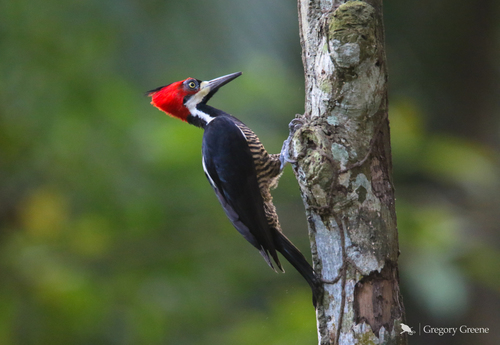
For the nominate subspecies C. m. melanoleucos, both sexes have black upperparts from the nape to the nape, with brownish black rumps, wings, and tail. They have vertical white stripes along the sides of the neck that continue onto the back and form a "V" shape. The edges of their flight feathers are pale white, yellow, or yellowish white. Their throat, front and sides of the neck, and upper breast are black. Their lower breast and belly range from pale cinnamon buff to tawny, marked with wide black bars. Their undertail coverts are pale yellow to yellowish white. They have a long, ivory-colored chisel-shaped bill, irises that range from white to yellow, and legs in variable shades of gray. Adult males have a mostly red head, with a white to pale yellow patch at the base of the bill and a small black and white spot on the ear coverts. Adult females have black feathers around the eye and on the front of the crest. They have a wide white stripe with black edges that runs from the bill to the ear coverts, then continues narrower down the side of the neck. Juveniles resemble adult females, but juvenile males have red on the sides of the head, and all red markings on the head are paler in juveniles of both sexes.
Subspecies C. m. malherbii has a gray rather than ivory bill, more red around the eyes than the nominate subspecies, and more extensive, deeper cinnamon-buff underparts. Subspecies C. m. cearae is almost identical to the nominate subspecies, but is smaller and has a disproportionately shorter tail.
The nominate subspecies of crimson-crested woodpecker is by far the most widespread. It occurs on Trinidad; from eastern Colombia east through Venezuela and the Guianas; along the eastern side of the Andes in eastern Ecuador, eastern Peru, northern Bolivia, and northern Paraguay; across most of Amazonian Brazil; and extends slightly into Misiones Province in northeastern Argentina. Subspecies C. m. malherbii is found across most of Panama and in northern and central Colombia. Subspecies C. m. cearae occurs in northeastern Brazil, ranging from Maranhão east to Ceará and south to Bahia.
The crimson-crested woodpecker lives in a wide variety of landscapes, most of which are forested. It favors large tracts of humid lowland forest such as terra firme, riparian forest, and mature secondary forest. It also occurs in somewhat more open areas including plantations, as long as tall trees are present.