About Campephilus leucopogon (Valenciennes, 1826)
The cream-backed woodpecker (Campephilus leucopogon) is 28 to 30 cm (11 to 12 in) long and weighs 203 to 281 g (7.2 to 9.9 oz).
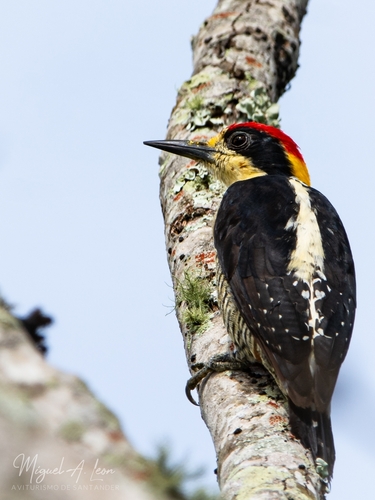
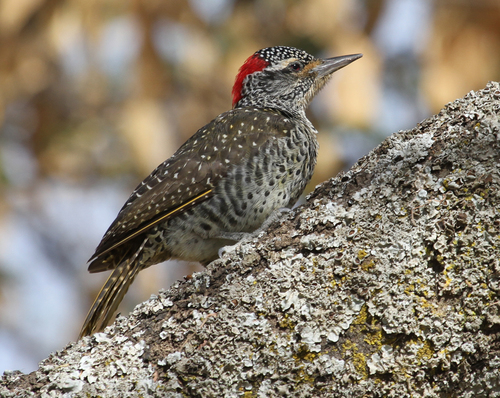
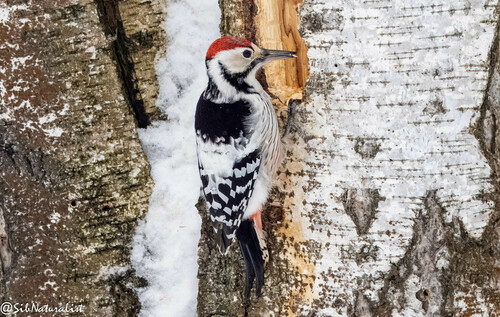
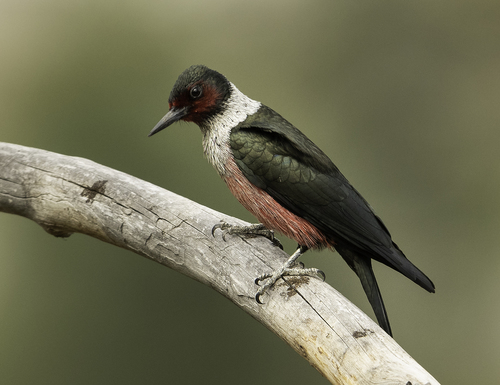
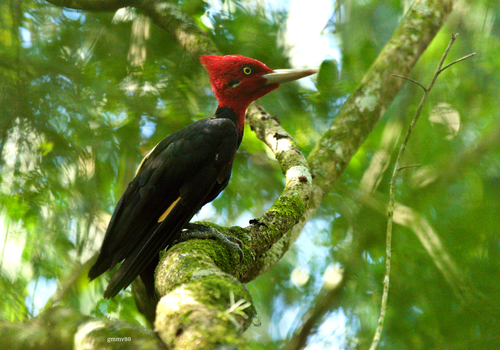
Adult males have a crest. Their entire head, crest, and neck are red, except for a small black and white spot on the ear coverts. Adult females have a longer crest than males and lack this ear covert spot. Females have a creamy band running from the bill to the ear coverts; a black patch above this band surrounds the eye and extends along the front of the crest, and a thinner black line runs below the creamy band. The rest of a female’s head is red, and her neck is black.
Adults of both sexes are mostly black below the neck. They have a whitish upper back with pale cinnamon-buff feather tips, and sometimes a few buff-and-black barred feathers in the center of the back. The bases of the inner webs of their flight feathers have a large amount of pale cinnamon. Their bill is a long, ivory-colored chisel shape, their iris is pale yellow, and their legs are gray.
Juveniles look similar to adults, but have less red overall, and the red they have is more orange. Juvenile males resemble adult females, with a red crown and crest; juvenile females have less red on the head than adult females.
This species is distributed from north-central Bolivia and western and central Paraguay, east and south to north-central Argentina, northern Uruguay, and Rio Grande do Sul in southeastern Brazil. It inhabits generally open landscapes in the dry Gran Chaco, including savanna, woodlands, transitional forest, pastures with tree copses, and palm groves. It occurs at elevations up to 2,500 m (8,200 ft).