About Campephilus gayaquilensis (R.Lesson, 1845)
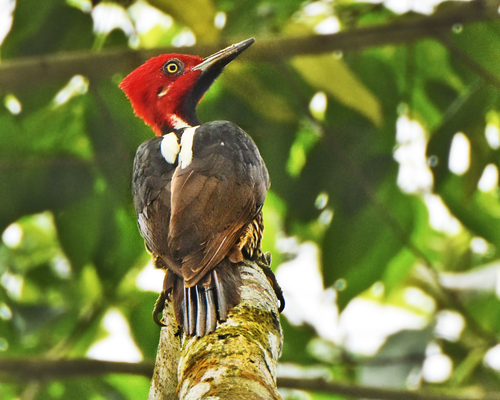
The Guayaquil woodpecker, scientific name Campephilus gayaquilensis (R.Lesson, 1845), measures 32 to 34 cm (13 to 13 inches) in length and weighs 230 to 253 g (8.1 to 8.9 oz). For individuals of both sexes, the upperparts from the neck to the upper back are black, and the area from the lower back to the uppertail coverts is barred with whitish buff and blackish. White stripes run along the sides of the neck, continue onto the upper back, and meet to form a "V" shape. The upper surface of the wings is brownish black to black; flight feathers are browner, with small cinnamon or buff spots on their inner webs. The underside of the wing feathers is white, with brown tips and trailing edges, and pale cinnamon bases on the primaries. The tail is dark brown to black-brown. The throat and upper breast are black, and the rest of the underparts are whitish buff to pale cinnamon-buff with brownish black bars. Adult males have an entirely red head, with a small black and white spot on the ear coverts. Adult females lack this ear covert spot, and instead have a wide creamy stripe with black edges that extends from the bill to the ear coverts, then bends downward to meet the white neck stripe. Adult Guayaquil woodpeckers have a long grayish chisel-shaped bill with a paler mandible, a pale yellow iris, and gray-brown to greenish gray legs. Juveniles resemble adults but have less barring on the rump and underparts; juvenile males have heads that look like those of adult females, and juvenile females have more black on their heads than they will as adults. The Guayaquil woodpecker is distributed from Cauca Department in southwestern Colombia, south through western Ecuador (west of the Andes) into Cajamarca Department in northwestern Peru. It lives in the interior and edges of dry to humid deciduous forest, as well as mature secondary forest. In terms of elevation, it reaches as high as 1,100 m (3,600 ft) in Colombia, and as high as 1,500 m (4,900 ft) in Ecuador and Peru, though it mostly occurs below 800 m (2,600 ft) in Ecuador and Peru.