About Campanulastrum americanum (L.) Small
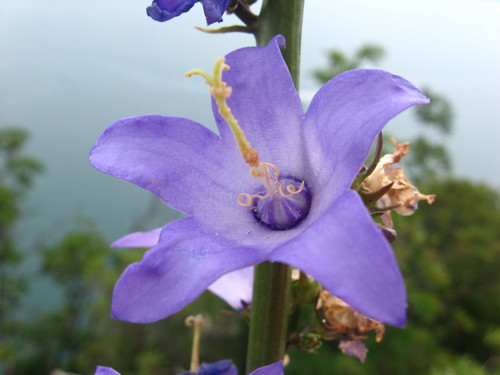
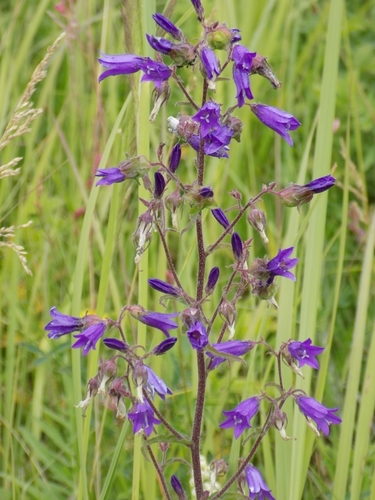
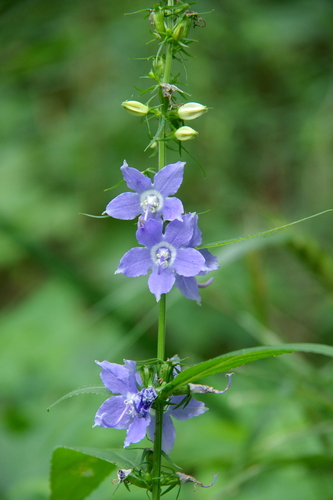
Campanulastrum americanum (L.) Small, commonly called American bellflower, has a morphological structure where a large central flower stem grows from a circular basal rosette of leaves. Flowers are borne on short stems branching off the central stalk in an arrangement called a raceme. The plant reaches an overall height of 3 to 6 feet. Its central stem is light green, slightly grooved, and covered in hairs, and it has a primary taproot system. Leaves are arranged alternately along the stems, measure 3 to 6 inches in length, and range from lance-shaped to ovate-elliptic, with rough, toothed edges. Leaves taper toward their base and toward the tip on upper stems, and the upper surface of the leaf is rough. American bellflower flowers range in color from light blue to violet, with a pale white ring at the flower throat. They primarily bloom during the summer months of June, July, and August. Unlike most bellflowers, this species has flat flowers rather than the bell shape the group is named for. Flowers are approximately 1 inch across, and can grow singly or in clusters. They are radially symmetrical, with 4 to 5 petals that have ruffled edges and pointed tips. Each flower has 5 stamens, 5 petals, and 5 sepals; its pistil has a recurved style and a three-lobed anther. After pollination, ovaries develop into five-angled, flat-topped seed pods. American bellflower is native to the Eastern United States, with its distribution clustered latitudinally along the Mississippi River. Its range extends from the Great Lakes region (including southern Ontario) south to Florida, and from the Dakotas east to New York. It has been recorded in the U.S. states of Alabama, Arkansas, Florida, Georgia, Iowa, Illinois, Indiana, Kansas, Kentucky, Louisiana, Maryland, Minnesota, Maine, Missouri, Mississippi, North Carolina, Nebraska, New Jersey, New York, Ohio, Oklahoma, Pennsylvania, South Carolina, South Dakota, Tennessee, Virginia, Wisconsin, and West Virginia. This species thrives in partial shade and rich loamy soil. It grows in circumneutral soil with a pH ranging from 6.8 to 7.2, and is found growing along woodland edges, in open woods, shaded meadows, stream banks, and ditches. No elevation range data is available due to its wide distribution, but it grows in USDA Hardiness Zones 4 to 8. American bellflower is self-compatible and is protandrous, meaning it displays sequential hermaphroditism. Its mating strategy is plastic, able to adapt to environmental changes and dependent on pollinator abundance. When pollinators are abundant, the species reproduces via out-crossing, or breeding between different individuals. When pollinator numbers are low, the plants can reproduce via self-pollination. Pollen ranges in color from dark purple to light tan. Fruiting bodies are capsules that are present from August to March, and each capsule holds many seeds. Seeds are oblong, with a pebbled surface and a winged margin, typically measuring 1.3-1.6mm long and 1.5-1.7mm wide. American bellflower seeds are not usually specifically targeted by predators. They are light and small, which suits their primary dispersal method of water dispersal. It has been proposed that ants may act as a secondary mode of seed dispersal. The amount of light and nutrients received by the maternal plant influences the germination timing of its offspring, and this germination timing controlled by maternal tissue in turn determines the species' life history strategy, governing whether offspring will be annual or biennial. Seeds that germinate in fall produce annual plants, while seeds that germinate in spring produce biennial plants. Biennial plants grow a basal rosette in their first year, then bloom in their second year from a tall stalk that grows out from the rosette. Long-tongued bees, including species in the Bombus genus and the Megachilidae family, are the primary pollinators of American bellflower. This includes Megachile campanulae, a bee that exclusively pollinates flowers in the bellflower genus Campanula. Halictid bees, butterflies, hummingbirds, and skippers also act as pollinators for this species. There are no significant pest or disease threats to American bellflower. It is sometimes eaten by slugs, snails, aphids, and white-tailed deer. In cultivation, American bellflower is popular for decorative landscaping and grows well when planted in large mass groupings. It grows in USDA Hardiness Zones 4 to 8. Native American groups have used different parts of American bellflower to treat respiratory conditions. The Haudenosaunee treated whooping cough with an infusion made from the plant's root, and the Meskwaki used the leaves to treat coughing and tuberculosis.