About Campanula uniflora Gorter
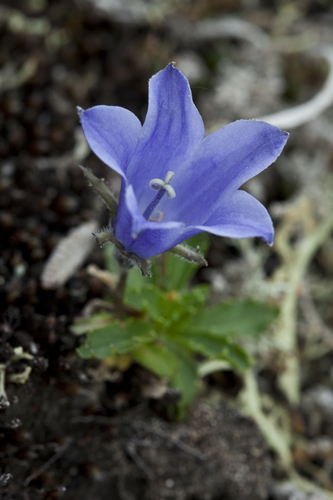
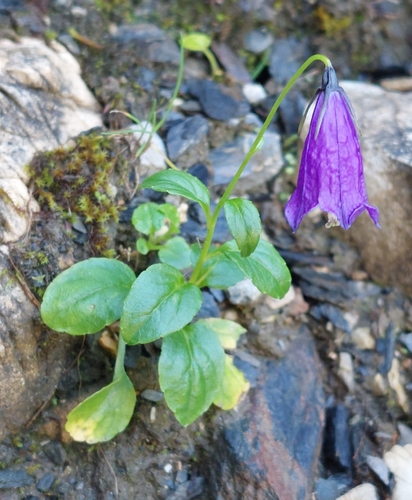
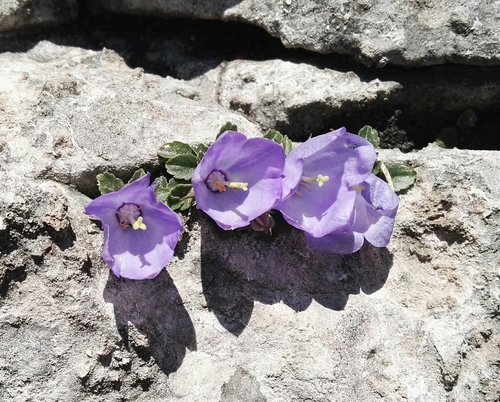
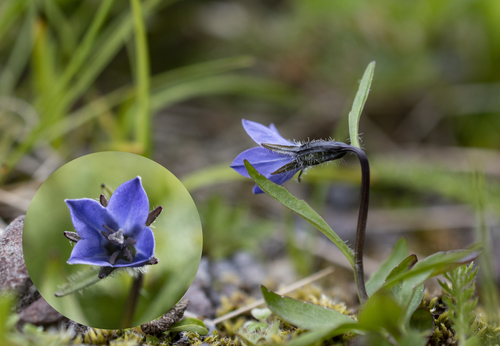
Arctic harebell, scientifically named Campanula uniflora Gorter, is a small perennial herbaceous plant that typically grows 5 to 14 centimeters tall. However, in the early 1900s, exceptionally tall 22 cm specimens were collected on the southern coast of the Coronation Gulf in Northern Canada. Each individual plant has a large, wrinkled main taproot. Multiple slender underground stems grow from this taproot to the soil surface, where leaf rosettes form; these underground stems bear leaves that are reduced to scales. In younger plants, the top of the main root lies closer to the soil surface, and the underground stems are much shorter. The leaves of this species are hairless, with either smooth edges or crenulate (very finely wavy toothed) edges. Basal leaves, which grow directly from the base of the plant, are oval to lanceolate (spear-head shaped), around 2 centimeters long, and have very short petioles. During blooming and for a short period after blooming, the tip of the stem bends to hold the flower hanging downward. As the seed capsule develops, the stem straightens to hold the capsule upright. Flowers are solitary at the end of each stem, with petals fused into a blue funnel that measures 15 to 18 millimeters long. In Iceland, Campanula uniflora acts as a host for Pleospora herbarum, a common pathogenic fungus. Campanula uniflora is widespread across the northern hemisphere. In Europe, it is native to Iceland, the Fennoscandian Peninsula (covering Norway, Sweden, and Finland). In Norway, it occurs as far south as 62° N in an isolated population in the southern Scandinavian Mountains, and is more common in the north, where its range extends into Sweden. It is also part of the native flora of the Faroe Islands, Svalbard, North European Russia, and the Novaya Zemlya archipelago south of 74° N. Further east in Asia, the species has been documented in the Russian Far East, including Chita Oblast, the Sakha Republic, Khabarovsk Krai, Magadan Oblast, the neighboring Chukotka Autonomous Okrug, and the Kamchatka Peninsula. Across the Bering Strait in North America, it is native to the entire far northern region from Alaska to Greenland. In Greenland, it grows on both the east and west coasts, excluding the far south, and rarely occurs on the north side of the island. Further south, it grows in the northern parts of Manitoba, Québec, and Labrador. In western North America, its range extends south along the Rocky Mountains through British Columbia and Alberta into the United States, where it occurs in Washington, Idaho, Montana, Utah, Wyoming, Colorado, and New Mexico. This species is uncommon, and prefers to grow in alkaline soils or on rocks.