About Campanula thyrsoides L.
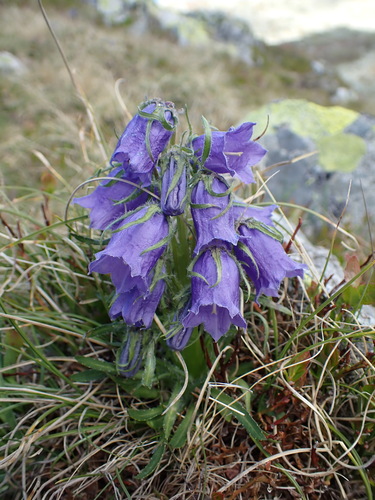
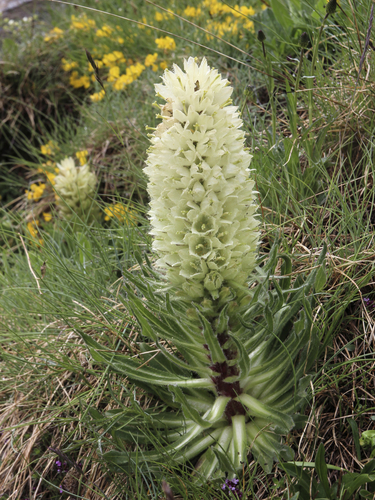
Campanula thyrsoides L. is a herbaceous, erect, perennial flowering plant that grows to a height of approximately 70–100 cm (28–39 in). It produces a prominent, dense inflorescence holding up to 200 pale yellow, bell-shaped flowers. Its stem is densely covered in leaves: basal leaves are elongated and lanceolate, while stem leaves are tongue-shaped. While it is generally described as perennial, its life cycle follows a biennial pattern: it completes all vegetative growth in its first year of life, then blooms and produces fruit in its second year. Overwintering buds form at ground level. Flowering typically occurs from July to August, and may begin as early as June in some cases. This species consists of hermaphroditic plants. Pollination can happen either through insect activity (entomogamous pollination) or via self-pollination (autogamy). Each capsule fruit holds between 120 and 180 seeds, and seeds are dispersed by barochory, meaning they fall to the ground under their own weight. This species is widespread across the Alps, the Jura Mountains, and the Balkans, with confirmed presence in Austria, Germany, Switzerland, Bosnia and Herzegovina, Bulgaria, Croatia, northern Italy, Serbia, Slovenia, and France. It grows on limestone alpine lawns in alpine or subalpine zones, generally at altitudes between 1500 and 2600 meters, and can occasionally be found as low as 1000 meters.