About Campanula punctata Lam.
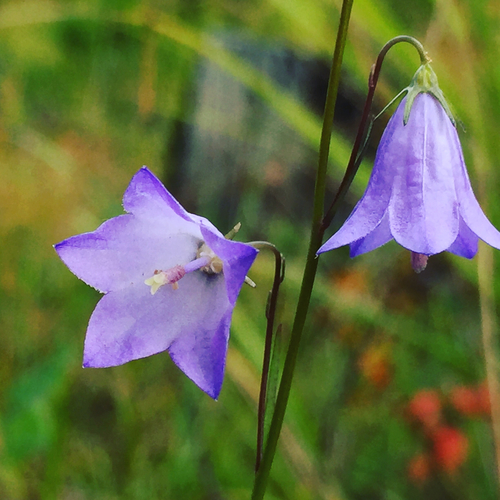
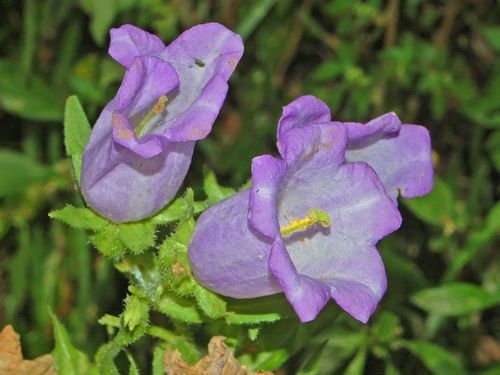
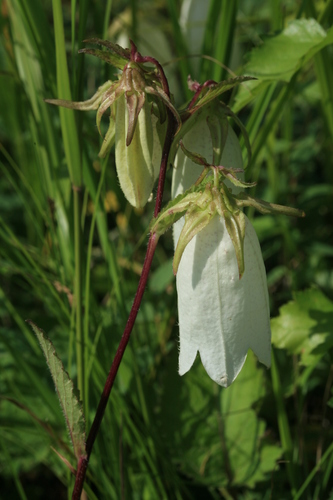
Campanula punctata Lam. typically reaches 30 to 100 centimeters (0.98 to 3.28 feet) in both height and width. It grows from stolons and produces upright stems. Its basal leaves are long, ovate, and heart-shaped. Leaves on flowering stems are arranged in rosettes, and are short and ovate; all leaves are alternate and toothed. The entire plant, including its flowers, stems, and leaves, is covered in hairs. This species grows in sunny East Asian forest edges, thickets, and meadows at elevations below 2300 meters. In China, it is found in eastern Gansu, Hebei, Heilongjiang, western Henan, western Hubei, Jilin, Liaoning, Nei Mongol, Shaanxi, Shanxi, and northeastern Sichuan. It is also widely distributed across Japan, Korea, and the Russian Far East (Siberia). Campanula punctata is valued for its highly ornamental flowers, and is widely cultivated in temperate regions of the Northern Hemisphere. Multiple forms and cultivars have been developed for cultivation: 'Pantaloons', 'Pink Chimes', 'Wedding Bells', Campanula punctata f. rubriflora, Campanula punctata f. rubriflora 'Wine 'n' Rubies', and Campanula punctata var. takesimana, also called Korean bellflower. This species grows best in moist, alkaline or neutral soil, and in conditions with full to partial sunlight. It is recorded as extremely hardy, and can tolerate temperatures of −20 °C (−4 °F) and lower.