About Campanula patula L.
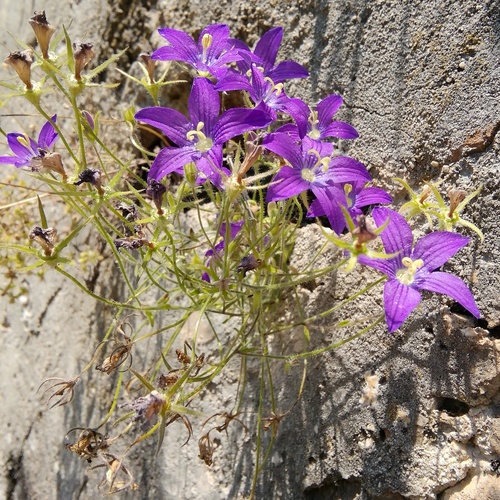
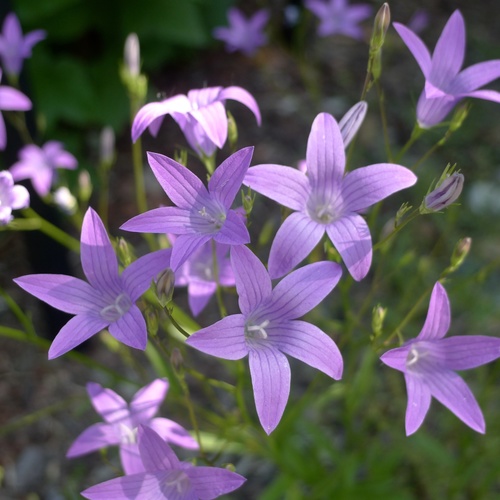
Campanula patula L., commonly called spreading bellflower, is a biennial herbaceous plant that reaches 25 to 80 centimetres (9.8 to 31.5 in) in height. Its stem is branched, erect, and wiry, and often takes on a reddish color near the base. In its first year of growth, the plant produces a rosette of short-stalked, slender, spatulate leaves. In its second year, it grows one or more flowering stalks. The leaves on these flowering stalks are alternate, linear, and unstalked, with rounded teeth along their margins. The inflorescence is a terminal raceme that bears a small number of flowers. The calyx is fused, with five triangular, sharp-tipped, spreading lobes. The corolla is five-lobed, 20 to 25 mm (0.8 to 1.0 in) long, and formed from five fused violet-blue petals, which are occasionally white. The corolla lobes are longer than they are wide. The flower has five stamens and a pistil formed from three fused carpels. The fruit is a conical capsule with strong veining. This species flowers from June to September. Spreading bellflower is native to temperate regions of Europe and is widely naturalized in other areas. Its natural habitats include meadows, banks, open woodland, clearings, roadside verges, fallow fields, and waste ground. In the United Kingdom, it is rare in the wild, and grows mainly on infertile banks and rock outcrops. Its seeds require light to germinate, so the plant may reappear after many years of absence when soil is disturbed. A bellflower weevil from the genus Miarus is associated with this plant.