About Campanula latifolia L.
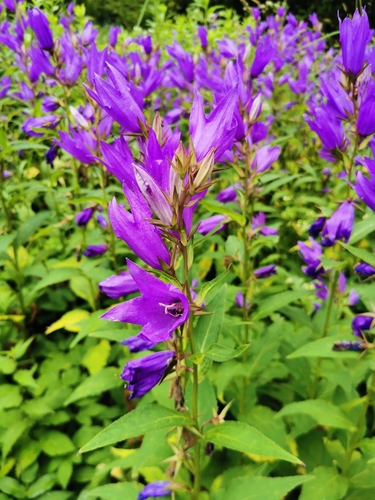
Campanula latifolia L. is a clump-forming perennial herbaceous plant that reaches 60 to 120 centimeters (24 to 47 inches) in height. Its stem is unbranched, erect, and covered in short hairs. Basal leaves are stalked, broadly ovate with a heart-shaped (cordate) base, while upper leaves are ovate-lanceolate, stalkless, softly hairy, and have bluntly toothed margins. Inflorescences are many-flowered terminal racemes, or grow in the axils of upper leaves, and have subtending bracts. The flowers are hermaphroditic, bell-shaped, 35 to 60 mm (1.4 to 2.4 in) long, and start erect before becoming nodding. The calyx is fused, with five narrow lobes that spread out over time. The corolla is covered in hairs, made of five fused dark violet-blue petals. Five stamens and one pistil are present, the pistil formed from three fused carpels. The fruit is a hairy, nodding capsule. This species flowers from July to September. It is native to Europe and western Asia, ranging as far east as Kashmir. Its natural habitat includes broad-leaved woodland, coppices, parkland, and forest margins. Some wild populations are the result of escape from cultivation. In cultivation, it grows easily even in partial to full shade, and is hardy in zone 5. It seeds freely to become naturalized, and can also spread via rhizomes. To sow, wait until seed heads turn dark brown, then open them and spread the seed. It withstands drought quite well.