About Campanula glomerata L.
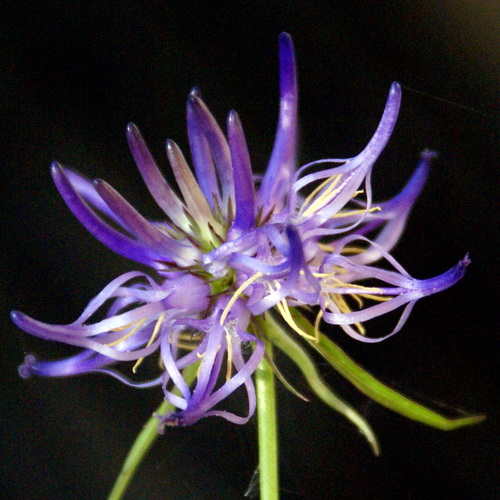
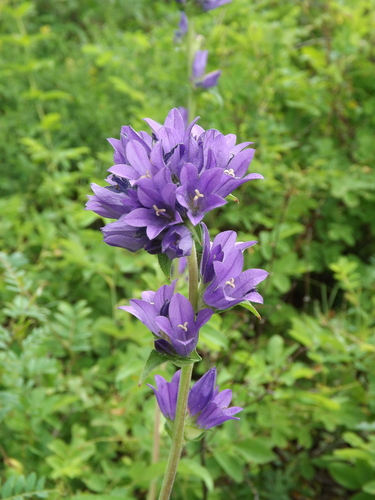
Campanula glomerata L. is a perennial herbaceous plant. It typically grows 20–60 centimeters (7.9–23.6 inches) tall, and can reach a maximum height of 90 centimeters (35 inches). Its stem is simple, erect, and covered in short hairs. Basal leaves have petioles, are oval-lanceolate in shape, and have a slight heart-shaped (cordate) base. Cauline (stem) leaves are lanceolate, stalkless, and clasp the stem. The inflorescence consists of 15 to 20 individual sessile, radially symmetrical, hermaphrodite flowers, each measuring about 2 to 3 centimeters across. These flowers are arranged in terminal racemes or in the axils of upper leaves, and are surrounded by an involucre of bracts. The corolla is bell-shaped, hairy, and has five dark violet-blue or purplish-blue petals. This species flowers from June to September. This species is native to the North Temperate Zone of Eurasia, ranging from Britain to Japan. It is found across almost all of Europe, except for the extreme far north. It has become naturalized in North America. It grows in forests, dry grasslands, scrub, open woodland, grassy moderately dry sites, wood edges, and along road and trail margins. It prefers calcareous soils, and grows at altitudes up to 1,500 meters (4,921 feet) above sea level. Campanula glomerata is widely cultivated in gardens, and cultivated varieties produce flowers in a range of colors including white, pink, blue, and purple. Numerous cultivars have been developed for garden use. Notable cultivars include 'Joan Elliott', which bears large violet flowers, and white-flowered 'Schneekrone'. The vigorous cultivar 'Superba' grows to 60 centimeters (24 inches) tall, has rich blue flowers, and has earned the Royal Horticultural Society's Award of Garden Merit. The pale purple cluster-flowered cultivar 'Caroline' has also received this award.